21.08.2026
Nohur: The Mountain Citadel of Alexander’s Heirs and the Mystery of the Horned Necropolis
Nohur: The Mountain Citadel of Alexander’s Heirs and the Mystery of the Horned Necropolis
High in the misty embrace of the Kopet Dag Mountains, where rocky peaks pierce the clouds and the air is filled with the scent of juniper and wild mint, lies a place that time itself seems to have left outside the ordinary course of history. This is Nohur.
If Merv was the heart of the plains, Nohur is an impregnable fortress built by nature itself. The people who live here have preserved a way of life, appearance and system of beliefs so distinctive that anthropologists have debated their origins for decades. Nohur is more than a village. It is a world of its own, with its own customs, dialect and unique tradition of honouring the memory of ancestors.
Part 1: The Origins of the Nohurli — The Blood of Hellas in the Mountains of Asia
The greatest mystery of this region is its people, the Nohurli. They are often described as noticeably different in appearance from the inhabitants of Turkmenistan’s plains. Fair complexions, sometimes blue or green eyes, strong profiles and athletic builds have contributed to numerous legends about their ancestry.
The Legend of Alexander’s Warriors
According to one of Nohur’s most enduring traditions, passed from grandfather to grandson beside family hearths, the villagers are descendants of the elite soldiers of Alexander the Great, known locally as Iskander Zul-Qarnayn.
- A Strategic Outpost: According to legend, when Alexander led his armies through the mountains towards the Indus, he left a military garrison here to guard an important mountain pass. The soldiers, captivated by the beauty of the mountains and the daughters of the local tribes, are said to have settled here permanently.
- Linguistic Traces: The local dialect contains words and expressions not commonly found in other regions, and some researchers have attempted to identify possible traces of ancient Greek or broader Indo-European linguistic influences. The Nohurli themselves proudly preserve the belief: “The blood of Iskander flows through our veins, and his fearlessness lives in our hearts.”
Part 2: The Horned Necropolis — One of the World’s Most Unusual Cemeteries
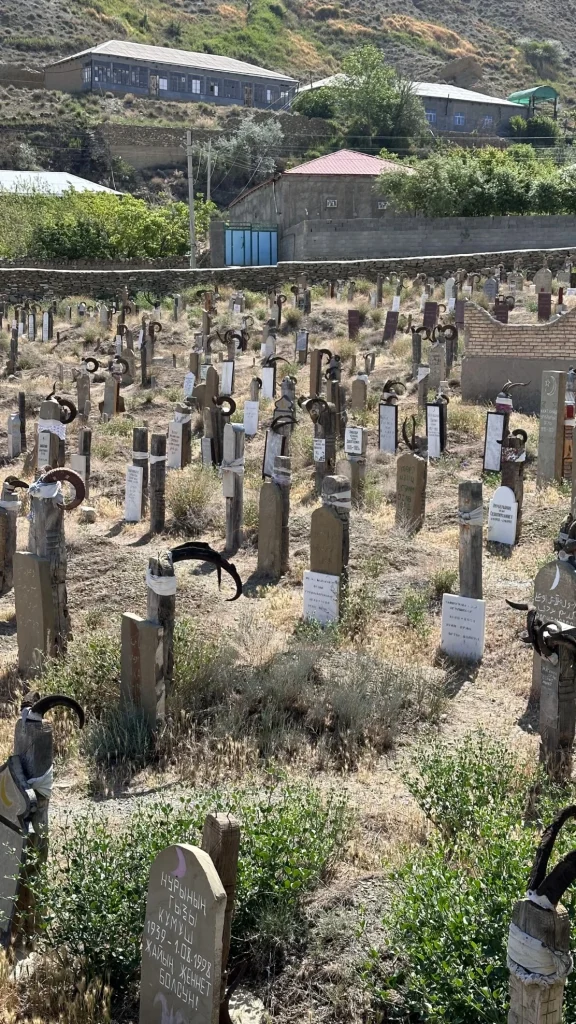
For many travellers reaching Nohur, the village cemetery is the most striking sight of all. Its appearance is unlike that of most traditional cemeteries elsewhere in the region.
The Cult of the Mountain Goat
Many gravestones here are decorated with large, curved horns of mountain goats or wild sheep.
- Spiritual Protection: In local tradition, the mountain animal symbolises purity, strength and resilience. The horns placed on graves are believed to serve as powerful protective symbols, guarding the deceased from evil spirits and other harmful forces.
- The Connection with the Two-Horned One: The name Zul-Qarnayn is commonly translated as “the Two-Horned One”. In ancient iconography, Alexander was sometimes depicted with the ram horns associated with the god Amun. Local tradition sometimes connects the horns placed on graves with the memory of Iskander. Symbolically, they form a bridge between the world of the living and the realm of the dead, allowing the soul to rise towards the heavens as effortlessly as a mountain sheep climbs the steepest cliffs.
Part 3: Ethnography and Daily Life — Living on Stone Terraces
Life in Nohur has always required constant adaptation to the mountains. The village lies among steep slopes, where almost every piece of cultivable land has been wrested from the rocky landscape.
Stone Architecture
Traditional houses in Nohur are built from natural mountain stone, often using little mortar.
- Fortress-Like Homes: Buildings stand closely together, forming a maze of narrow lanes where sometimes only one person can pass at a time. This type of mountain architecture offers protection from both intruders and the cold winter winds.
- Terraced Gardens: Look towards the slopes and you will see the mountains transformed into enormous steps. Pomegranates, grapes and walnuts grow on these terraces. The traditional irrigation system is a remarkable example of local engineering, directing meltwater from the mountains through narrow channels carved into the rocky landscape.
The Sacred Plane Tree
In the centre of the village stands an enormous plane tree, believed to be centuries old.
- A Living Grotto: The hollow inside its massive trunk is large enough for several adults to stand inside at once. The tree is considered sacred. Women traditionally come here to pray for children and tie colourful pieces of cloth or ribbons to its branches. According to local belief, its roots reach deep into the mountains, connecting the world of the living with the spirits of the ancestors.
Part 4: Traditional Crafts — Keteni Silk and the Language of Patterns
Nohur is also associated with the traditional Turkmen silk fabric known as keteni.
- Hand Weaving: In many homes, the rhythmic sound of a traditional wooden loom can still be heard. Techniques for dyeing threads with natural materials, including madder roots and pomegranate peel, have traditionally been passed down through generations.
- Symbolic Ornament: Patterns woven into Nohur textiles can carry symbolic meaning. Red is traditionally associated with the energy of life, while long stripes may be interpreted as roads or journeys. Clothing made from finely woven Turkmen silk has long been valued for its beauty, craftsmanship and cultural significance.
Part 5: The Mystery of Gyz-Bibi — The Cave of Hope
Not far from the village lies another place associated with local legends — the shrine of Gyz-Bibi, a small cave in the mountains that has become a place of pilgrimage.
- The Legend: According to local tradition, during an enemy attack a beautiful young woman named Gyz-Bibi prayed to be saved. The rock miraculously opened and sheltered her within the mountain.
- The Ritual: Pilgrims traditionally come here to make a wish and attempt to attach a small piece of wet clay to the cave ceiling. If the clay remains in place, it is believed that the wish may come true. The ceiling is dotted with countless small pieces of clay — tiny “drops of hope” left behind by generations of visitors.
Part 6: Flora and Fauna — A Protected Mountain World
The natural environment surrounding Nohur is remarkable. The Kopet Dag Mountains create a distinctive local ecosystem.
- Wild Grapes and Walnut Trees: Ancient groves and wild plant varieties survive in the region, recalling periods when the local climate was different from today.
- The Persian Leopard: The Kopet Dag region is one of the remaining habitats of the rare Persian leopard, a powerful predator that survives in remote and inaccessible mountain areas. Local traditions often treat the leopard with deep respect as a symbolic “master of the mountains”.
- Medicinal Herbs: The mountains around Nohur are rich in aromatic and medicinal plants. Local mountain honey and traditional herbal mixtures are highly valued throughout Turkmenistan.
Part 7: Practical Guide — A Journey into a Hidden Mountain World
A journey to Nohur combines mountain scenery, traditional culture and a sense of travelling far beyond the usual tourist routes.
- The Road: The journey from Ashgabat takes several hours. The final section towards the village passes through mountainous terrain with steep and winding roads, making an experienced driver highly recommended.
- Etiquette: The Nohurli are known for hospitality, but local traditions remain conservative. When visiting cemeteries and sacred places, travellers should behave respectfully and quietly. Modest clothing is advisable.
- Where to Stay: Nohur is not a destination for large luxury hotels. Instead, eco-tourism and homestays offer a more authentic experience. Staying with a local family gives travellers an opportunity to taste traditional Nohur cuisine, enjoy home-cooked meals and hear local stories directly from residents.
- What to Buy: Traditional textiles, locally produced silk and mountain honey are among the most characteristic souvenirs from the region.
Epilogue: The Lesson of Nohur
Nohur teaches the value of loyalty — loyalty to one’s roots, one’s land and one’s memories. In an age of globalisation, when places around the world can increasingly begin to resemble one another, this “island in the mountains” continues to preserve its identity with the stubborn determination of a mountain goat standing at the edge of a precipice.
To visit Nohur is to discover a community whose identity has been shaped by mountains, legends and generations of inherited traditions.
And when you stand beside the Horned Necropolis at sunset, watching the peaks of the Kopet Dag turn shades of crimson and purple, you may feel that the ancient legends have never truly disappeared. Iskander still seems to linger here — in the stories of the people, in the strength of the stone walls and in the eternal whisper of the mountain wind.
🏆 Quiz from the “Great Book”
The Nohurli preserve an old tradition associated with trees and ancestral memory. Do you know which tree found in the Nohur region is sometimes called the “tree of life”, is capable of surviving for more than a thousand years, and was valued by ancient craftsmen for its exceptionally dense, aromatic and durable timber?
Hint: It is a conifer with remarkably strong and fragrant wood.