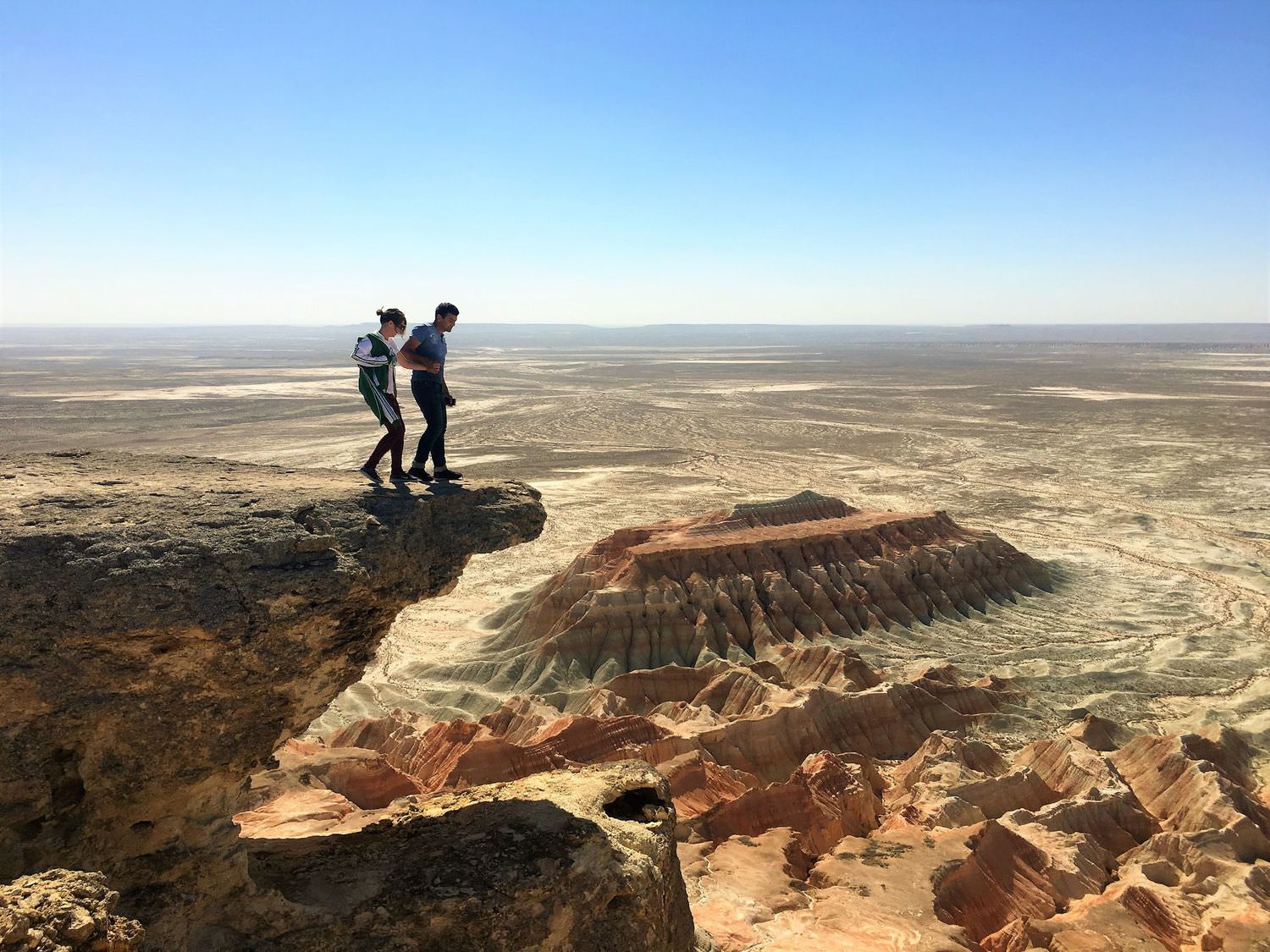
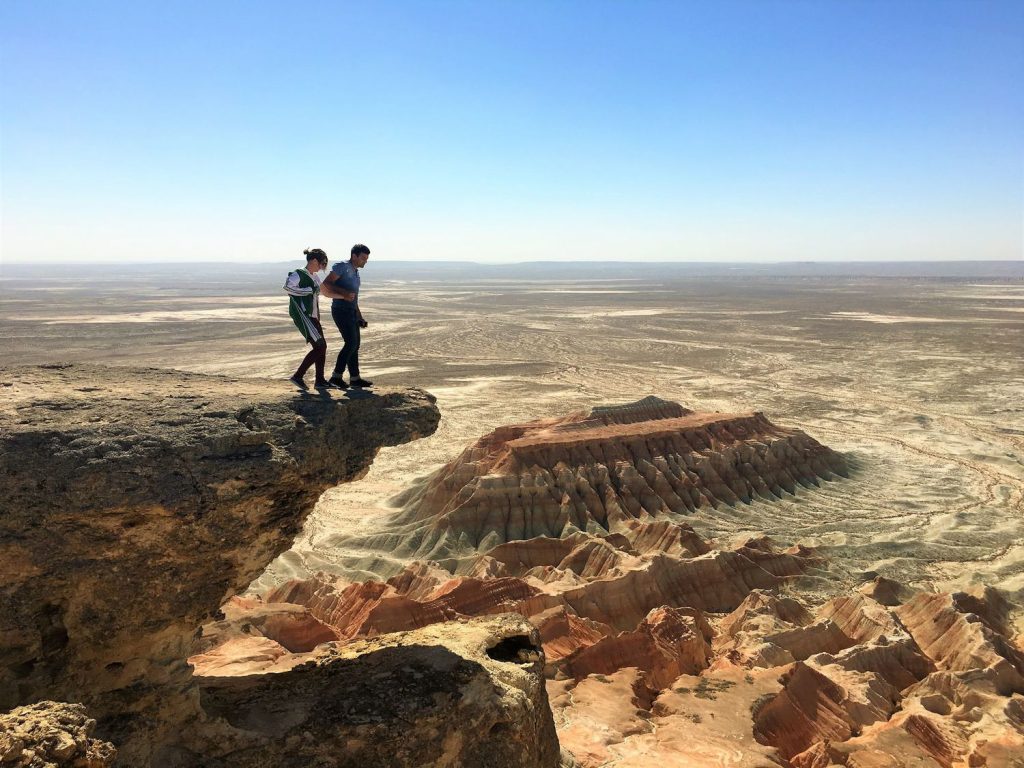
Millions of years ago, the waters of a vast sea raged where these cliffs now stand. If you wish to behold a place where the Earth bares its soul, where time is measured in eons and colours defy reality, you must journey to the north-west of Turkmenistan, into the Balkan Velayat. Here, tucked away amidst harsh desert plateaus, lies one of the planet’s most breathtaking natural wonders — the Yangy-Kala Canyons.
The name “Yangy-Kala” translates from Turkmen as “Fiery Fortresses”. This title is no poetic accident. When the setting sun kisses the jagged ridges of the cliffs, the entire landscape ignites with crimson, scarlet, and purple hues, transforming into a cinematic backdrop for a science-fiction epic set on a distant world. Often called the “Grand Canyon of Central Asia”, Yangy-Kala possesses something its American counterpart lacks: the profound silence and majesty of an untouched, primeval world.
Part 1: A Geological Saga — Upon the Bed of the Ancient Paratethys Sea
What we see today as gargantuan canyons and whimsical rock formations was, in truth, the floor of a prehistoric ocean. Between five and ten million years ago, this entire region was submerged beneath the depths of the ancient Paratethys Sea.
How was this wonder born?
- Sedimentary Strata: For millions of years, layers of limestone, marl, sand, and red clay accumulated on the seabed. Various mineral impurities — such as iron and manganese — tinted these layers in contrasting shades, ranging from dazzling white to vibrant pink and blood-red.
- Tectonic Uplift: As the sea receded and the Earth’s crust began to rise, the strata of the ancient floor were thrust onto the surface.
- The Sculptor Named Wind: Over millennia, rains, winds, and temperature fluctuations acted as master sculptors. They eroded the softer rocks, leaving behind only the resilient skeletons. Thus emerged the “celestial castles”, “stone mushrooms”, and giant amphitheatres we marvel at today.
Part 2: Nature’s Architecture — Castles Not Built by Human Hands
The Yangy-Kala Canyons comprise a vast depression, its edges serrated by deep fissures. Stretching for several dozen kilometres, every turn reveals a new, even more improbable vista.
The “Crocodile’s Head” and the “Sphinxes”
Among the thousands of crags are those with their own monikers. The most famous resembles the head of a prehistoric crocodile, frozen in stone. Others evoke the walls of medieval fortresses with battlements, the spires of Gothic cathedrals, or sphinxes waiting in eternal silence.
- Layers of Time: If you approach the canyon wall, you will see distinct horizontal lines. Every centimetre of this wall represents hundreds of years of Earth’s history. A keen-eyed traveller may find fossilised shells and the remains of crinoids (sea lilies) — mute witnesses to an oceanic past.
- A Symphony of Colour: The palette of Yangy-Kala shifts with the light. Morning brings soft pinks and pastels; midday turns the cliffs a blinding white and cream; but sunset is the crescendo. The rocks turn fiery orange, creating the illusion that they are glowing from within.
Part 3: Legends of the Fiery Fortresses
Though a natural site, Yangy-Kala is shrouded in myth. For centuries, local nomads avoided these areas after nightfall.
- The Legend of the Caravan-Bashi: It is told that a wealthy caravan once lost its way in these lands. The leader, dying of thirst, prayed for mercy. The heavens opened and the earth collapsed, revealing a path to water, but the caravan was turned to stone to serve as an eternal reminder of the fragility of human life before the desert.
- Spirits of the Wind: The whistling of the wind in the narrow crevices often sounds like human voices or weeping. Local lore suggests these are the voices of ancient creatures who lived in the ocean and remained behind when the waters retreated.
Part 4: Flora and Fauna — Life Against the Heat
- Saxaul and Saltwort: Plants here possess mighty roots reaching depths of up to 20 metres. In spring, after rare rains, the canyons are carpeted in ephemeral flowers that vanish within weeks.
- Masters of the Canyons: One may spot urials (mountain sheep) leaping across sheer cliffs with improbable ease. In the sky, golden eagles and Egyptian vultures soar, scouting for prey.
- The Reptilian World: This is home to many lizards and the famous Central Asian Grey Monitor, often called the “desert crocodile”.
Part 5: The Explorer’s Guide
A journey to Yangy-Kala is one of the most challenging yet rewarding treks in Turkmenistan.
- Logistics: The canyons are roughly 165 km from Turkmenbashi and 160 km from Balkanabat. A 4×4 off-road vehicle is non-negotiable. There is no tarmac — only dusty tracks that become impassable after rain.
- Connectivity: There is no mobile signal or internet. You are alone with nature.
- Best Time to Visit: March to May (for the desert blooms) or September to November (for clear, photographic air).
- Survival Tip: The nearest settlement is hours away. Carry a minimum of 5 litres of water per person per day.
Part 6: A Photographer’s Paradise
For professional photographers, Yangy-Kala is the “Holy Grail”.
- Technical Tip: Use a wide-angle lens to capture the sheer scale. For the fossils and rock textures, a macro lens is invaluable. The “Golden Hour” — the 15 minutes before and after sunset — provides the most spectacular shots.
Epilogue: A Lesson of Millions of Years
Yangy-Kala teaches humility. Standing at the edge of this gargantuan rift, realising that every stripe on the rock is a thousand years of oceanic peace, your daily worries seem infinitesimal. This is a “place of power”, where one can hear the voice of eternity and witness the incredible beauty nature creates when left undisturbed by man.
🏆 Quiz from “The Great Book”:
Near the Yangy-Kala Canyons lies a sacred site — the pilgrimage centre of Gozli-Ata. According to legend, Gozli-Ata was a great Sufi who possessed an “all-seeing eye”. Do you know what extraordinary gift was attributed to this saint, and why pilgrims always visit his mausoleum before descending into the canyons? (Hint: It is believed he could see through mountains and predict the fate of travellers in the desert).