High within the misty embrace of the Kopetdag Range, where crags pierce the clouds and the air is thick with the scent of juniper and wild mint, lies a place that time itself seems to have granted an exemption from the frantic pace of history. This is Nokhur.
If Merv was the heart of the plains, then Nokhur is an impregnable castle forged by nature. It is home to a people whose way of life, appearance, and beliefs are so distinct that anthropologists have spent decades debating their origins. Nokhur is not merely a village; it is an autonomous universe with its own laws, its own dialect, and a cult of ancestral memory unlike any other.
Part 1: The Origins of the Nokhurli — Hellenic Blood in the Asian Highlands
The primary enigma of this region is the people themselves: the Nokhurli. They differ strikingly from the inhabitants of lowland Turkmenistan. Their light, occasionally blue or green eyes, proud profiles, and athletic builds betray a different genetic lineage.
The Legend of Iskander’s Warriors
According to the most enduring tradition, passed from grandfather to grandson by the hearths of Nokhur, the villagers are the direct descendants of the elite warriors of Alexander the Great (Iskander Zulqarnayn).
- A Strategic Outpost: It is said that as Alexander led his phalanxes through the mountains toward the banks of the Indus, he left behind a military garrison to guard a vital pass. Enchanted by the beauty of the mountains and the daughters of local tribes, the warriors stayed forever.
- Linguistic Traces: The local dialect contains layers of vocabulary found nowhere else, and some researchers attempt to find echoes of Ancient Greek or an Indo-European substrate within it. The Nokhurli believe fervently: “In our veins flows the blood of Iskander; in our hearts, his fearlessness.”
Part 2: The Horned Necropolis — The World’s Most Mysterious Graveyard
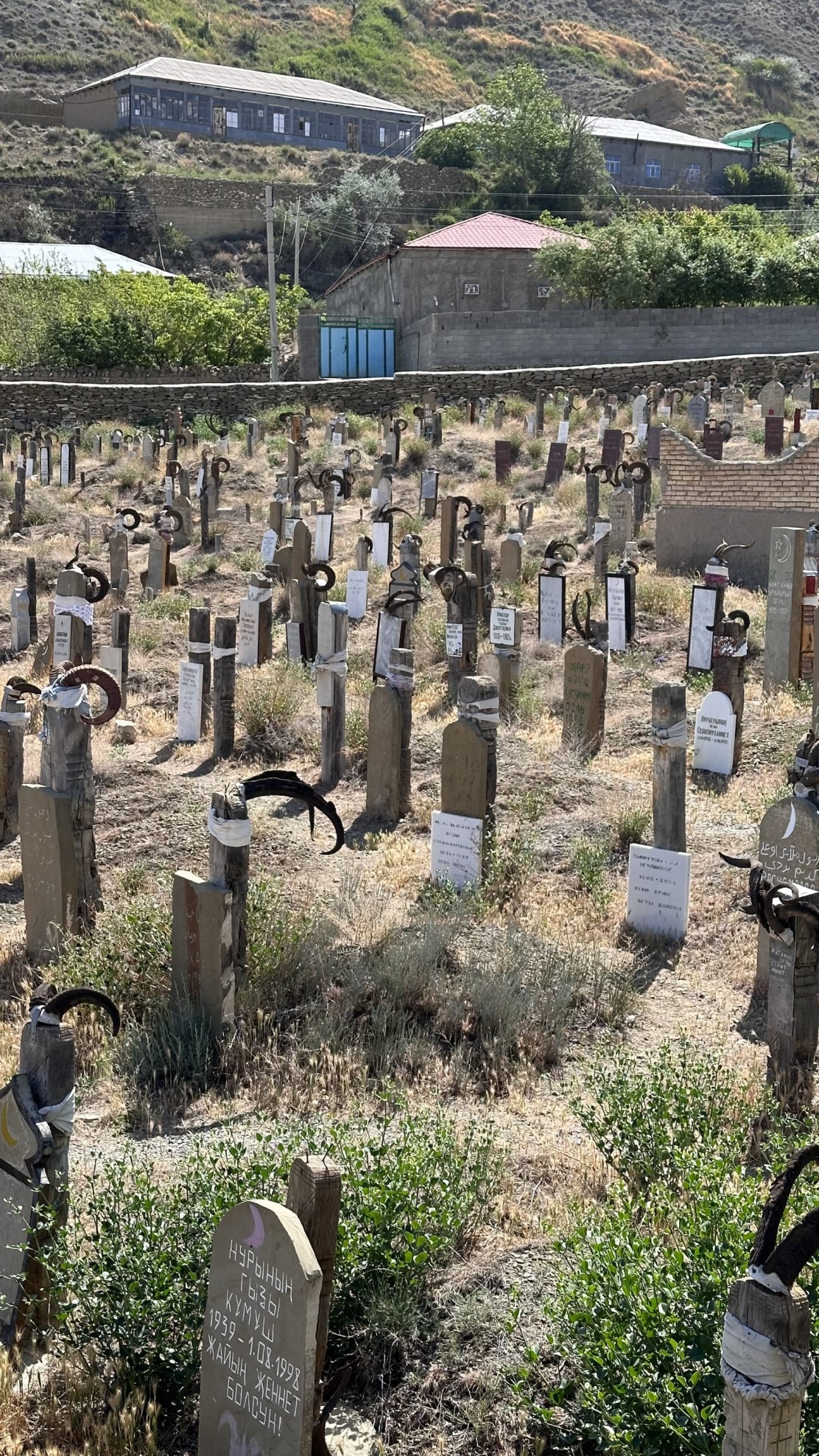
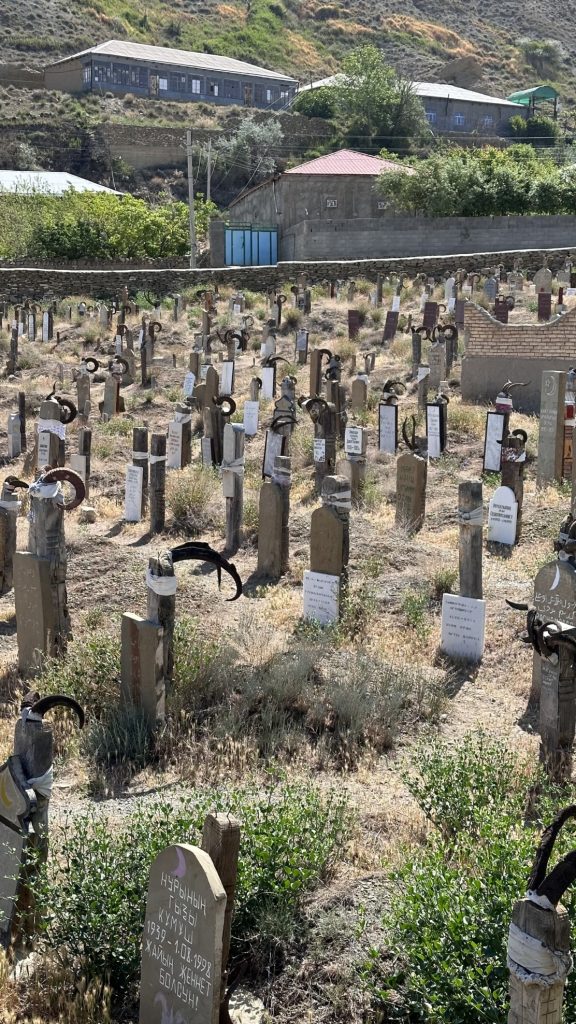
The greatest visual shock for any traveller reaching Nokhur is the local cemetery. It is a spectacle without parallel in the Islamic, Christian, or Pagan worlds.
The Cult of the Mountain Goat
Every headstone here is crowned with the massive, spiralling horns of the mountain goat (arkhar).
- Magical Protection: For the Nokhurli, the mountain goat is a sacred animal, a symbol of purity, strength, and invulnerability. The horns serve as a powerful talisman. It is believed they ward off evil spirits (djinns) who might disturb the peace of the deceased.
- The Link to the Two-Horned: The name “Zulqarnayn” means “The Possessor of Two Horns”. In antiquity, Alexander was often depicted with the horns of a ram or goat (the symbol of the god Amun). The Nokhurli consider the placement of horns on graves a tribute to their great ancestor, Iskander. It is a bridge between the world of the living and the realm of shadows, which the soul, like a nimble arkhar, can easily ascend.
Part 3: Ethnography and Daily Life — Life on the Stone Terraces
Life in Nokhur is a daily feat of interaction with stone. The village clings to steep slopes, and every scrap of earth has been reclaimed from the mountains.
Stone Architecture
Houses in Nokhur are constructed from wild mountain stone with little to no mortar.
- Fortress-Houses: Buildings are packed tightly together, forming a labyrinth of narrow alleys where barely one person can pass. This is the classical architecture of mountain citadels, designed to protect against both enemies and the biting winter winds.
- Terraced Gardens: The slopes are transformed into giant steps. Here grow unique varieties of pomegranate, grape, and walnut. The irrigation system is a masterpiece of folk engineering, where meltwater from the peaks is channelled through narrow aryks carved into the rock.
The Sacred Chinar
In the village centre stands a giant Oriental Plane tree (chinar), centuries old.
- A Living Grotto: Inside its massive hollow, five to seven adults can fit simultaneously. Women come here to pray for fertility, tying colourful ribbons to its branches. It is said the roots of this tree reach the very foundations of the mountains, linking the living with the spirits of the ancestors.
Part 4: Crafts — Keteni Silk and the Magic of Patterns
Nokhur is the cradle of Turkmenistan’s most durable and vibrant silk — Keteni.
- Hand-Weaving: In almost every house, one can hear the rhythmic clatter of the tara (wooden loom). The secrets of dyeing the threads with natural pigments — madder root, pomegranate skin — are guarded with fierce loyalty.
- Sacred Ornament: The patterns on Nokhur keteni are encoded messages. Red symbolises the fire of life, while longitudinal stripes represent the roads trodden by Iskander’s armies.
Part 5: The Mystery of Gyz-Bibi — The Cave of Hope
Near the village lies the shrine of Gyz-Bibi, a small cave that has become an object of deep veneration.
- The Legend: It is told that during an enemy raid, a beautiful maiden (Gyz-Bibi) prayed for salvation, and the cliff split open to receive her into its depths.
- The Rite: Pilgrims come to make a wish and attempt to stick a small piece of wet clay to the cave’s ceiling. If the clay holds, the wish will come true. The ceiling is studded with thousands of these “droplets of hope”.
Part 6: Flora and Fauna — A Sanctuary World
- Relict Groves: Ancient clusters of wild grapes and walnuts survive here, remembering a time when the climate was far milder.
- The Persian Leopard: Nokhur is one of the few places on Earth where this magnificent predator still inhabits the inaccessible gorges. Locals treat it with mystical respect, calling it the “Master of the Mountains”.
- Medicinal Herbs: The Nokhurli are master herbalists. Their mountain honey and herbal infusions are prized nationwide as elixirs of longevity.
Part 7: Practical Guide — A Journey to a Lost World
- The Road: The drive from Ashgabat takes 3–4 hours. The final serpentine ascent to the village is steep and winding, requiring an experienced driver.
- Etiquette: The Nokhurli are hospitable yet conservative. Observe silence at the cemetery and shrines. Women are advised to wear a headscarf and clothing that covers shoulders and knees.
- Stay: Eco-tourism is developing through homestays. This is the best way to sample authentic Nokhur cuisine — be sure to try the Nokhur Palov infused with mountain herbs.
Epilogue: The Lesson of Nokhur
Nokhur teaches us loyalty: loyalty to one’s roots, one’s stones, and one’s memory. In an age of globalisation, this “island in the mountains” preserves its identity with the stubbornness of a mountain goat standing on the edge of proof. To visit Nokhur is to realise that true human strength lies not in technology, but in the connection to the land that raised us.
When you stand at the edge of the Horned Necropolis and watch the setting sun paint the Kopetdag peaks in purple, you will feel it: Iskander has not left. He remains here — in the eyes of these people, in the strength of these walls, and in the eternal whisper of the mountain wind.
🏆 Quiz from “The Great Book”:
The Nokhurli observe an ancient custom: when a child is born, a tree is planted in their honour; when a person passes, their grave is adorned with horns. Do you know which tree in Nokhur is considered the “Tree of Life”, capable of living for over a thousand years, and why its wood was valued by ancient masters more than gold? (Hint: It is a coniferous tree with exceptionally dense, fragrant, and eternal wood).