If Old Nisa (Mithradatkert) was a secluded “Olympus” for kings and gods, then New Nisa was its earthly manifestation — a bustling, clamorous, and incredibly wealthy metropolis. Situated just a mile and a half from the royal residence, New Nisa served as the economic, artisanal, and political hub of the Parthian state for over fifteen hundred years.
In this chapter, we descend from the heights of the royal hill into the thick of the city quarters to understand how an ordinary Parthian lived, how the empire’s grandeur was forged in the marketplaces, and why this city continued to flourish even when the names of the great Arsacids had been all but forgotten.
Part 1: The City That Refused to Die
The name “New Nisa” can be somewhat misleading. In truth, this city emerged almost simultaneously with Old Nisa, yet unlike its royal neighbour, it was never a “time capsule” reserved for the elite.
- Longevity: Whilst Old Nisa lost its significance as early as the 3rd century AD, New Nisa remained a living city well into the Middle Ages (17th–19th centuries). It survived the fall of Parthia, the dominion of the Sassanids, the Arab conquest, a renaissance under the Seljuks, and the terrifying Mongol raids.
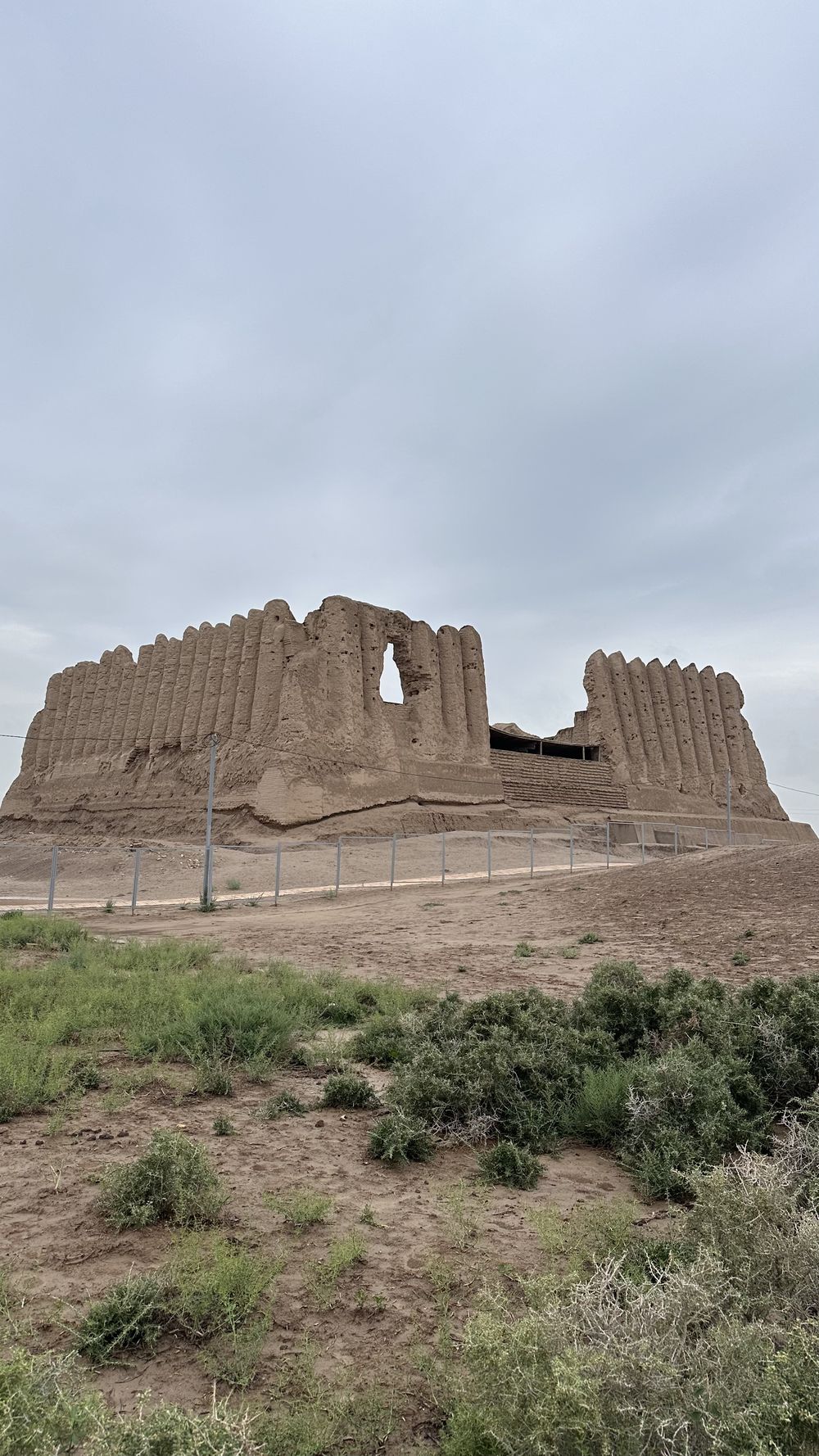
- The Plan: This was a classical Oriental fortress spanning some 18–20 hectares. It took the form of an irregular quadrilateral, encircled by colossal walls which, at their peak, reached a height of 15 metres.
Part 2: Architecture of Survival and Comfort
In New Nisa, archaeologists discovered a starkly different picture from the royal residence. Here, everything was dictated by practicality, commerce, and defence.
Walls and Fortification
The walls of New Nisa are a masterpiece of mud-brick fortification.
- Layered History: Research shows that the walls were extended and reinforced over centuries. Within the walls lay galleries for archers, with formidable towers rising every 20–30 metres. These walls withstood dozens of sieges; even today, their weathered contours resemble impregnable cliffs.
- The Moat: The city was surrounded by a deep moat, filled in antiquity with water from mountain streams, making a direct assault virtually impossible.
Residential Quarters and Workshops
Excavations within the city revealed a dense urban fabric:
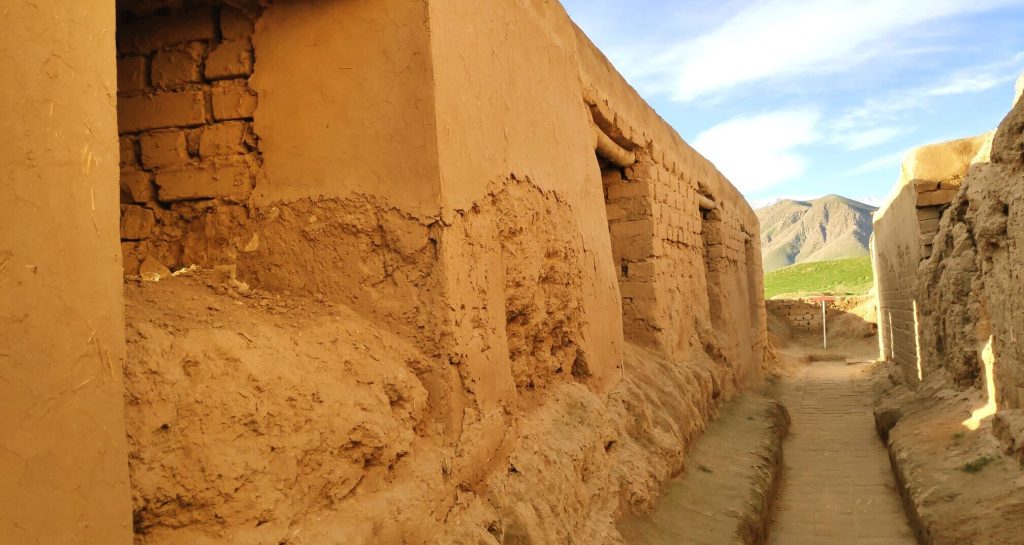
- Urban Dwellings: These were multi-room structures with internal courtyards typical of the East. Walls were adorned with murals, and floors were paved with fired brick.
- The Wine Industry: New Nisa was a viticultural powerhouse. Vast wine cellars have been found containing dozens of khums — giant clay vessels buried in the earth. Each storehouse could hold thousands of litres of wine. On ostraka (pottery shards), scholars found records of wine deliveries: “Wine from such-and-such vineyard for the needs of the temple.”
Part 3: Economy on the Great Silk Road
New Nisa was the “customs gate” of the empire. It was here that caravans travelling from China to Rome made their primary halt before traversing the Kopetdag Mountains.
- Market Squares: Archaeologists found vast open spaces within the city that likely served as bazaars. They would have been redolent with spices, leather, fresh bread, and costly incenses.
- The Mint: It was in New Nisa that copper and silver coins bearing the portraits of Parthian kings were struck. The Parthian drachma was a hard currency of the age, recognised from India to Egypt.
- Metallurgy: Here, the famed Parthian armour was forged for the cataphracts — heavy cavalrymen entirely encased in scaled steel. The secret of this steel and the method of fastening the plates was a state secret, guarded zealously behind the walls of New Nisa.
Part 4: Religious Pluralism
New Nisa was a remarkably tolerant city. Within its walls, diverse cultures and faiths coexisted:
- Zoroastrianism: As the state religion, it maintained its fire temples here.
- Hellenism: Greek gods — Zeus, Athena, Heracles — were venerated by locals alongside Iranian deities.
- Christianity and Buddhism: In later periods (4th–6th centuries), New Nisa became home to Nestorian Christians and Buddhist communities. Objects bearing Christian symbols found by archaeologists prove the city’s incredible openness to the world.
Part 5: A Medieval Renaissance — The City of Nisa
Following the fall of Parthia, the city did not vanish. In the Islamic period, it became known simply as Nisa and evolved into one of the cultural centres of Khorasan.
- The Seljuk Era: In the 11th and 12th centuries, the city experienced a second blossoming. Magnificent mosques and madrasas were built. The city was famed for its theologians, who bore the surname al-Nisai.
- The Tragedy of 1221: Genghis Khan’s Mongols besieged Nisa. The city resisted desperately but fell. The walls were razed, and the population suffered a brutal massacre. However, unlike Old Nisa, New Nisa rose from the ashes once more, continuing to exist for several centuries until it was finally abandoned due to climate change and the receding waters.
Part 6: Myths and Mysteries of New Nisa
Folk legends frequently link New Nisa with secret subterranean passages.
- The Secret Tunnel: For centuries, locals believed that New and Old Nisa were connected by a wide underground tunnel, allowing the King to ride unnoticed on horseback from the palace to the city. Whilst archaeologists have yet to find direct evidence, the complex system of qanats (underground aqueducts) in the area is sophisticated enough to have inspired such tales.
- The Last Ruler’s Hoard: It is said that before the Mongols breached the gates, the treasurers hid the gold in a deep, dry well. The hoard is protected by a “djinn of the sands,” and only one with a pure heart may find the way to it.
Part 7: Tips for the Deep Explorer
Whilst Old Nisa strikes one with the majesty of its ruins, New Nisa is a paradise for those who cherish the finer details.
- How to View: The walls of New Nisa are much better preserved on the northern side. Climb one of the surviving towers — from there, you are granted a panorama of Old Nisa and the modern vineyards of Bagir village.
- Look for Ceramics: The surface of the site is strewn with pottery fragments from various eras — from coarse Parthian ware to exquisite Islamic glazes. (Remember: this is a UNESCO site; you may observe, but you must not remove!).
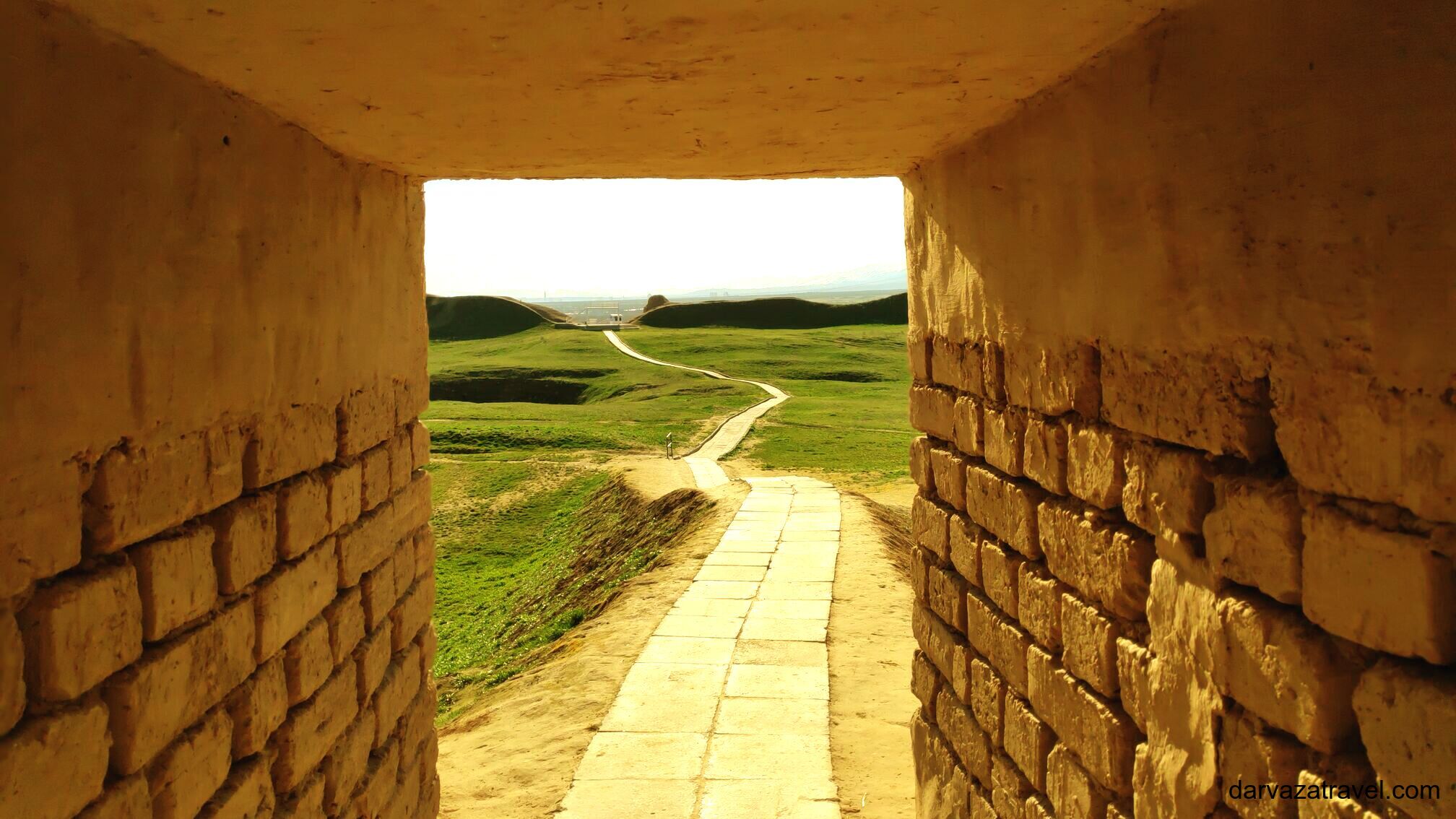
- The Comparison: Notice how New Nisa feels more “grounded” and lived-in. There are no vast halls like those in Old Nisa, but instead, a labyrinth of alleyways where it is easy to imagine the clamour of an Oriental bazaar.
A Word from Your Guide: New Nisa teaches us that empires are built on swords but survive through trade and the toil of craftsmen. It was the industrious city that fed and clothed the glittering Old Nisa. Walking here, you touch the daily lives of those who created the great Parthian state.
🏆 Quiz from “The Great Book”:
Parthian winemakers in Nisa utilised a fascinating technology for clarifying wine. They added a specific natural substance to the vessels (khums) which absorbed sediment and made the wine clear and long-lasting. Do you know what this “secret ingredient” was, harvested in the foothills of the Kopetdag? (Hint: It is a special type of white clay that is still used today in medicine and cosmetology).