Welcome to a place that for millennia bore the title ‘Maru-Shahu-Jan’ — ‘Merv, the Soul of Kings’. If human history were a necklace, Merv would be its largest and most radiant diamond. This is not merely a city; it is a colossal laboratory of civilisations, sprawling across more than 100 square kilometres within the Murghab River oasis.
In this chapter, we embark on an epic 2,500-year journey, treading streets once walked by Alexander the Great and peering into observatories where Omar Khayyam calculated the movements of the stars. Ancient Merv is not simply an archaeological park; it is a sacred site where the sands of the Karakum Desert have for centuries guarded the secrets of the greatest empires.
In 1999, this unique complex was inscribed onto the UNESCO World Heritage List. Its vast 1,200-hectare territory represents a ‘wandering city’: each epoch built its new centre alongside the previous one, creating a unique chronicle of humanity. Merv is exceptional because it is not a single city grown layer upon layer in one spot. It is a constellation of cities built side-by-side. As one era succeeded another, rulers did not destroy the old, but erected the new nearby, creating an ensemble unprecedented in world archaeology where one can literally step from Antiquity into the Middle Ages, and from the Middle Ages into the era of great empires.
4,000 Years of Grandeur: A Chronology of the ‘Soul of Kings’
Merv (ancient Margiana) is one of the oldest centres of civilisation in Central Asia. Its history is a path from a fortress on the fringes of Persia to the largest metropolis in the world.
- 6th–4th Century BC: A mighty citadel of the Achaemenid Empire.
- 4th–3rd Century BC: Hellenistic flowering. The city was renamed Alexandria in Margiana in honour of Alexander the Great.
- 3rd Century BC – 2nd Century AD: A vital outpost of the Parthian Kingdom.
- 9th–13th Century: The ‘Golden Age’. Under the Great Seljuks, Merv became the capital of a vast empire stretching from China to the Mediterranean.
Part 1: Erk Kala and Gyaur Kala — The Cradle of Antiquity
Our journey begins at the most ancient core of Merv — the citadel of Erk Kala. It was founded in the 6th century BC during the era of the powerful Achaemenid Empire. Imagine a colossal earthen rampart rising above the desert. This was an impregnable fortress, the heart of the wealthy satrapy of Margiana.
Alexander the Great and the Greek Legacy
In the 4th century BC, Alexander the Great arrived here. Struck by the fertility of the oasis, he ordered the city to be rebuilt. Later, under the Seleucids, the city expanded and transformed into Gyaur Kala — the ‘Fortress of Infidels’ (as it was later named by the Arabs).
- The Layout: Gyaur Kala is a perfect square with walls two kilometres long. Inside, the life of the Hellenistic world teemed: there were Greek theatres, temples, and workshops.
- Religious Crossroads: Gyaur Kala was a unique place where Zoroastrians, Buddhists, and Christians lived as neighbours. One of the oldest Buddhist monasteries in Central Asia and a Nestorian Christian church were discovered here.
Part 2: Sultan Kala — The Golden Age of the Great Seljuks
In the 11th century, Merv reached its absolute zenith. It became the capital of the Great Seljuk Empire. It was at this time that Sultan Kala was built — a city that rivalled Baghdad and Constantinople in its majesty and wealth.
Sultan Sanjar: Lord of the World
The central figure of this era was Sultan Sanjar. Under his rule, Merv became the cultural capital of the Islamic world.
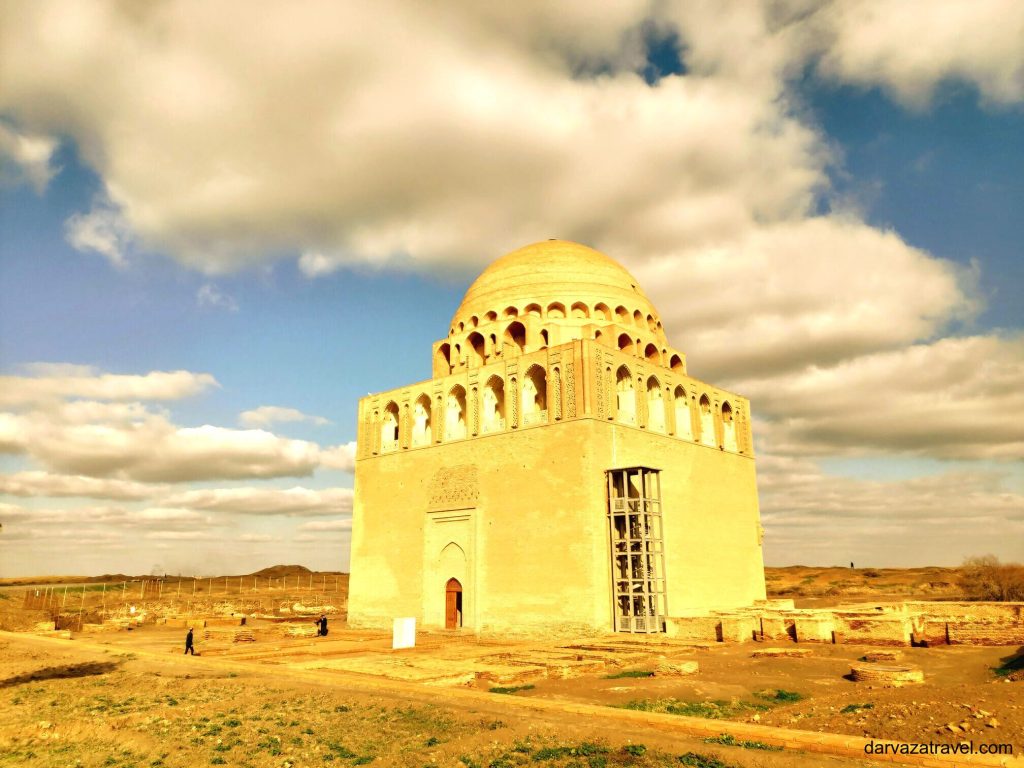
- The Mausoleum of Sultan Sanjar (1157): This building is the pinnacle of medieval architecture. Its enormous turquoise dome was visible to caravans a full day’s journey from the city. Legend has it that the dome was so grand that ‘one half of it was in the sky, and the other on the earth’.
- An Engineering Marvel: The dome was double-layered with an air gap, making the structure earthquake-resistant and light. The architect, Muhammad ibn Atsyz of Serakhs, created a masterpiece that has stood for nearly 900 years.
The City of Knowledge: Omar Khayyam in Merv
Sultan Kala housed ten of the world’s largest libraries. It was here that Omar Khayyam spent several years of his life. In the Merv observatory, he created the most accurate solar calendar in history, surpassing the modern Gregorian one.
Part 3: Greater and Lesser Kyz Kala — Castles of Amazons and Spirits
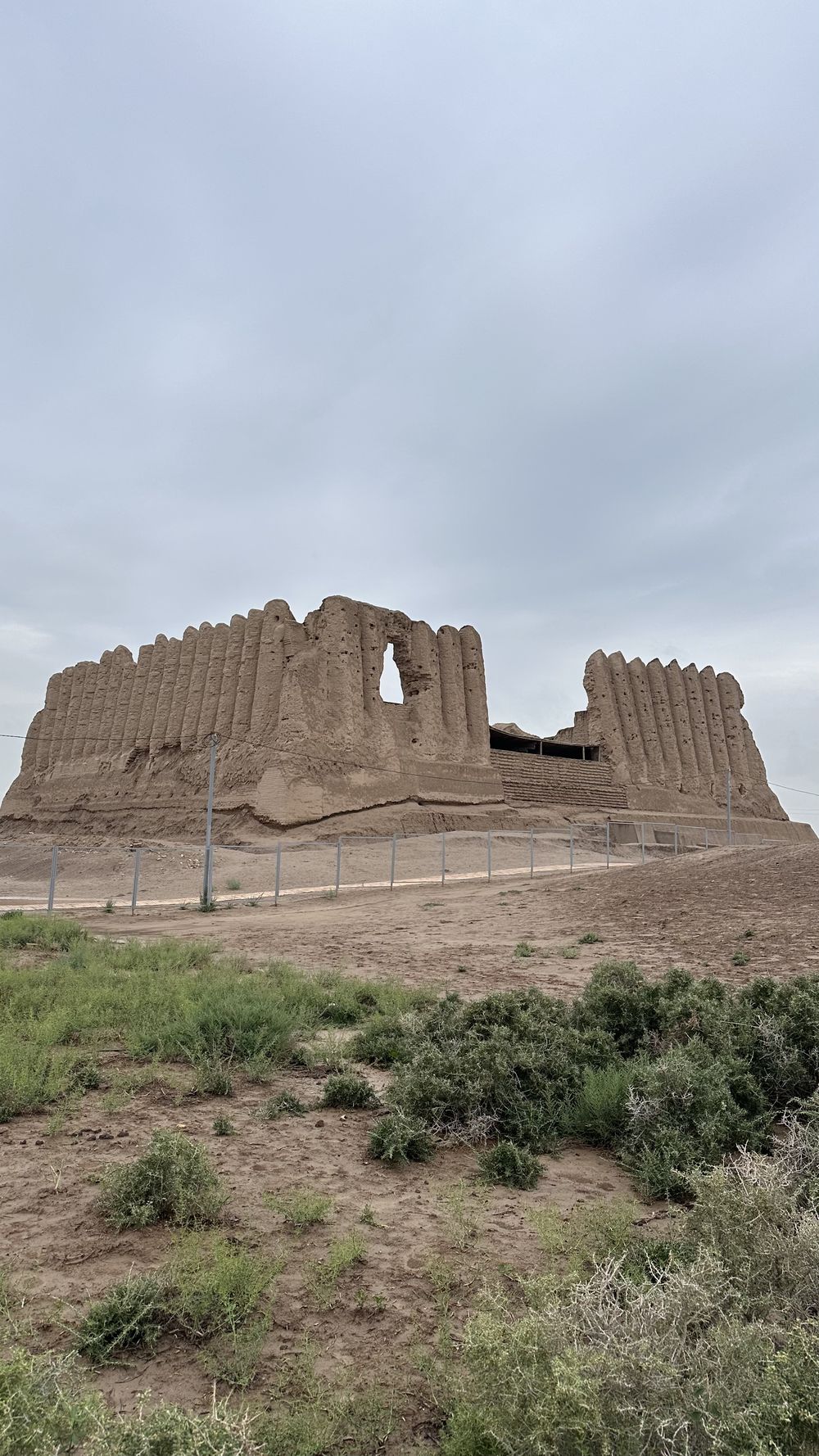
Among the most enigmatic sights of Merv are the koshks — fortress-palaces with corrugated walls. The most famous is Greater Kyz Kala.
- ‘Corrugated’ Architecture: The castle walls resemble the bellows of an accordion. This unique design served two purposes: first, it provided formidable defence (battering rams could not be effectively deployed); and second, the corrugations created shade, cooling the building in the summer heat.
- Legend of the Forty Maidens: It is believed that forty valiant warrior-maidens lived in this castle. Tradition says that if a youth wished to marry one of them, he had to throw a stone from Lesser Kyz Kala into the windows of Greater Kyz Kala.
- Mysticism: Locals believe that at night, one can hear the ring of weapons and the laughter of the warrior-beauties echoing through the corridors.
Part 4: Political Whirlwind — From Khwarazmshahs to the Mongol Tragedy
Merv was always a prize for conquerors. Following the Seljuks, it became part of the Khwarazmshah Empire. But in 1221, clouds of black dust appeared on the horizon — the hordes of Genghis Khan were approaching.
The Tragedy of 1221
The siege of Merv by the Mongols, led by Tolui (son of Genghis Khan), was one of the bloodiest chapters in human history. Merv surrendered without a fight, believing promises of mercy. However, the Mongols destroyed it completely.
- Scale of Catastrophe: Chronicles state that over a million people perished in those days. The city was razed, libraries burned, and the unique irrigation dams on the Murghab were blown up.
- Death of the Oasis: With the dams destroyed, the water vanished, and the once-blooming paradise turned into desert. Merv, the ‘Mother of Cities’, fell silent for centuries.
Part 5: Abdullakhan Kala and Bairamalikhan Kala — The Timurid Rebirth
Merv did not die entirely. In the 15th century, Shahrukh, son of the great Tamerlane, decided to revive the legendary city. He ordered the construction of a new fortress — Abdullakhan Kala.
- Timurid Style: The city featured the latest fortifications of the time. Inside were wealthy bazaars and mosques.
- The Ice Houses (Yakhdans): Unique conical ice houses have been preserved. In winter, ice was harvested and stored in deep cellars, lasting until the end of summer. Merv’s residents could enjoy cold drinks in 50-degree heat — a level of comfort unavailable to Europe at the time.
Part 6: Economy and Technology — How Merv Fed Half the World
- Cotton and Silk: Merv cotton (‘white gold’) was considered the finest in the East. Fabrics woven from it were worn by the Caliphs of Baghdad.
- Merv Melons: Renowned by travellers from Ibn Battuta to Marco Polo. The melons were sliced, dried, and sent in leather bags to all countries of the East as a precious delicacy.
- Metallurgy: The world’s oldest workshop for producing crucible steel (Damask) was discovered in Merv.
Part 7: Necropolises and Spirituality — Mausoleum of the Sahaba Brothers
Merv has always been a site of pilgrimage. One of the main sanctuaries is the necropolis of the Sahaba Brothers — companions of the Prophet Muhammad. These mausoleums with their high portals and turquoise domes remain places of silence and prayer.
Part 8: Archaeological Mysteries and Treasure Hunts
Merv is a paradise for archaeologists.
- The Lost Libraries: A legend persists that part of the Merv library treasures was hidden in underground vaults before the Mongol invasion.
- The City of Skeletons: Excavations revealed the horrifying details of the Mongol assault — layers of ash and bone — but among this death, beautiful jewellery, coins, and pottery are still found, telling the story of life.
Part 9: Merv in World Literature
Merv is mentioned in the tales of ‘The Thousand and One Nights’. Eastern poets once wrote:
“If you are offered a choice between Paradise and Merv — choose Merv, for you shall find Paradise after death, but Merv is Paradise during life.”
Part 10: Practical Guide for the Modern Traveller
- Scale: Do not attempt to explore Merv on foot. You will need a car to travel between the various city-sites (kalas).
- Route: Start at Erk Kala for a panorama of the oasis, visit Sultan Sanjar for Seljuk architecture, see Kyz Kala at sunset, and end with a pilgrimage to the Sahaba Brothers.
- Base: The best base is the city of Mary, 30 kilometres away. Be sure to visit the Regional Museum there to see the artefacts found at Merv.
Epilogue: The Lessons of Merv
Merv teaches us that civilisation is a fragile vessel. A city that was the capital of the world could be reduced to hills of dust in mere days. Yet it also teaches us of rebirth. Like a phoenix, Merv rose from the ashes again and again. Today, its ruins are the genetic code of the Turkmen people, their pride, and their message to the future.
🏆 Quiz from “The Great Book”:
In medieval Merv, there existed a unique profession — the ‘Mirab’. These individuals were the most respected in the city after the Sultan. Do you know exactly what they did and why the life of every resident in this giant metropolis depended on their honesty and knowledge? (Hint: The word is related to the distribution of the most precious resource in the desert).