Welcome to the foothills of the majestic Kopetdag Mountains, where, upon a high natural plateau, lie the ruins that serve as a testament to one of history’s most formidable and daring empires. This is Old Nisa.
In the realms of history and archaeology, it is customary to divide Nisa into two distinct parts. New Nisa was a sprawling commercial and residential metropolis, fortified by massive walls. But Old Nisa — which the Parthians themselves called Mithradatkert (“The Fortress of Mithradates”) — was something far more sublime. It was not a city in the conventional sense; it was a private royal residence, the sacral heart of the Arsacid dynasty. This was a place where monarchs were crowned, where sacrifices were offered to the gods, and where secret tombs housed the remains of those who once made Great Rome itself tremble.
Part 1: The Birth of an Empire — The Genesis of Parthian Glory
The story of Old Nisa begins in the 3rd century BC. Imagine the world following the death of Alexander the Great: his vast empire had fractured, and Greek governors — the Seleucids — ruled the eastern fringes. However, from the Caspian steppes came the Parni nomads, led by their chieftain, Arsaces I.
They did not merely seize land; they forged a new civilisation that synthesised the sophistication of Greek culture (Hellenism) with the rugged might of ancient Persian traditions. Old Nisa became their inaugural capital and primary sanctuary. It was from here that the Parthian mounted archers began the campaign that would eventually see Parthia emerge as the world’s second superpower — the only empire capable of meeting the Roman Legions as an equal.
Part 2: The Architectural Ensemble — A Labyrinth of Gods and Kings
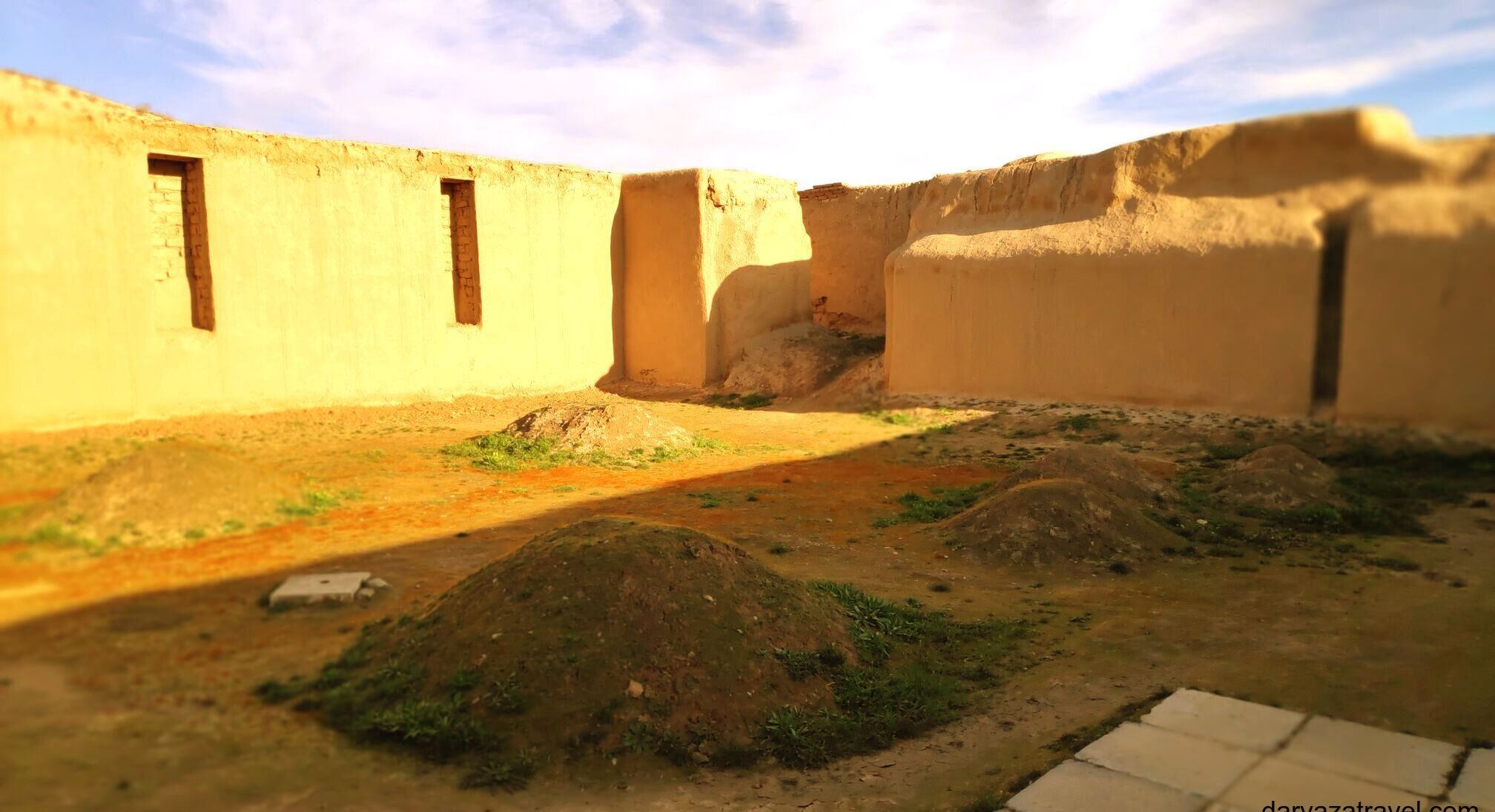
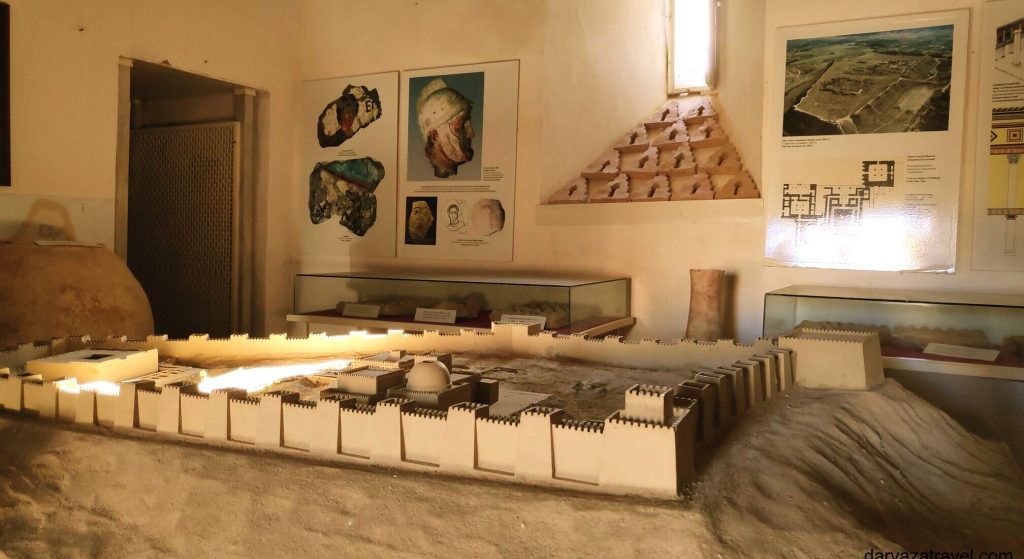
Old Nisa is a pentagonal fortress erected upon a man-made mound covering approximately 14 hectares. Its walls, fashioned from sun-dried mud bricks, reached a thickness of 8–9 metres and were reinforced by 43 rectangular towers. Yet, the true marvels lay within.
- The Square Hall — A Place of Feasts and Councils
This was a magnificent ceremonial structure (roughly 20 by 20 metres). The walls were painted in vivid red and white, while the ceiling was supported by formidable columns.
- A Throne Room? Scholars believe this hall hosted the solemn receptions and banquets of the “Council of the Nobility”. Picture Parthian aristocrats in silk-embroidered robes, reclining on couches as they debated campaigns against Marcus Crassus or Mark Antony.
- Clay and Colour: Archaeologists discovered fragments of clay statues here, painted so masterfully they appeared lifelike. These were depictions of deified kings and Greek gods rendered in Parthian guise.
- The Round Temple — The Enigma of the Celestial Dome
This is Nisa’s most unusual building: a perfect circle, 17 metres in diameter, inscribed within a square exterior.
- The Cult of Fire or Sun? It is believed the temple was dedicated to ancestral memory or to the Sun god, Mithra. The architecture was designed so that light entered in a specific manner, creating a mystical atmosphere during rituals. The columns featured unique capitals, blending the Ionic Greek style with Eastern motifs.
- The Square House — A Treasury of Millennia
This building was a true sensation for the scientific world. It consisted of a large courtyard surrounded by 12 rooms. Upon entering, archaeologists found the “archive” and “treasury” of the Parthian kings.
- Ivory Rhytons: It was here that the famous Nisa Rhytons were found — horn-shaped wine vessels adorned with exquisite carvings. They depict Greek deities, the Olympic Games, and scenes of Parthian life, proving that Nisa was a centre of the highest artistry.
- Parthian Ostraka: Thousands of inscribed pottery shards were found — the “account books” of the palace. From these, we have learned the volume of local wine production, the taxes paid by peasants, and even the names of the royal cupbearers.
Part 3: Political Weight — Nisa Against Rome
Old Nisa was more than a palace; it was an ideological headquarters where decisions that redrew the map of the world were made.
- The Battle of Carrhae (53 BC): When the Roman general Crassus (Rome’s wealthiest man) invaded Parthia, the cataphracts — heavy cavalry encased in steel — deployed from these very regions. The Romans were utterly routed. Legend has it that Crassus’s head was brought to the Parthian court just as a Greek tragedy, The Bacchae, was being performed.
- The Silk Diplomacy: Nisa stood at the crossroads. The Parthians were the first to monopolise trade between China and Rome; the gold of Rome settled here in exchange for Chinese silk.
Part 4: Myths and Legends of the Sacred Hill
- The Legend of the Immortal Guard: It is said that beneath a full moon, the shadows of horsemen are visible upon Nisa’s walls. This is the ghostly Arsacid guard, continuing to watch over their sovereigns.
- The Curse of the Golden Rhyton: Local lore suggests Nisa’s treasures are protected by an ancient spell. Anyone attempting to remove gold from the royal treasury with malice in their heart will be forever lost in the labyrinth of the Kopetdag Mountains.
Part 5: The Tragedy of Oblivion
In the 3rd century AD, a new dynasty — the Sassanids — rose to power in Iran. Fanatical enemies of the Arsacids, they sought to erase all memory of their predecessors. They seized Nisa, desecrated the royal statues, and demoted the sacred residence to a common fortress. Later came the Arabs and the Mongols, but time and earthquakes dealt the final blow. The mud walls eventually slumped, turning into the high mounds that hid the brilliance of former glory.
Part 6: Practical Guide for the Traveller
Old Nisa is the most accessible UNESCO site for visitors, located just 20 minutes from the centre of Ashgabat.
- When to Visit: An hour before sunset is ideal. The light paints the pakhsa (rammed earth) walls a deep orange, with the mountains providing a majestic backdrop.
- What to Observe: Seek out the Square Hall. Even without its roof, its scale is awe-inspiring. Look closely at the ground after rain; you may occasionally spot fragments of ancient ceramics (though you must leave them where they lie!).
- The Museum: After exploring the ruins, visit the National Museum of Turkmenistan in Ashgabat. This is where the original ivory rhytons and statues are preserved.
A Word from Your Guide: Old Nisa is a place for reflecting on the transience of time. Standing atop the citadel, you see the shimmering modern capital on one side and the eternal, rugged mountains on the other. One realises that empires come and go, but the spirit of creation remains in these stones forever.
🏆 Quiz from ‘The Great Book’:
The Parthians were famous for a military manoeuvre that has entered every tactical textbook as the “Parthian Shot”. Do you know the unique trick behind this move, which allowed horsemen to defeat superior forces even as they appeared to be retreating? (Hint: It required incredible horsemanship and the ability to shoot an arrow from a very unusual position).