Five to seven kilometres north of the majestic yet formidable walls of ancient Dekhistan, amidst shifting sands and the sun-cracked earth of the Misrian Plain, lies a place shrouded in such dense layers of legend that distinguishing history from myth is almost impossible. This is Mashad-ata—a memorial complex that, for over a thousand years, locals have called nothing less than the ‘Cemetery of the Sons of Iskander Zulkarnayn’ (Alexander the Great).
If Dekhistan itself was the body of the Khwarazmshah Empire—its commercial and military hub—then Mashad-ata was its spiritual heart, a mystical portal where time stands still and a prayer uttered in a whisper seems to reach the very heavens.
Part 1: The Shadow of Great Iskander — Between History and Myth
To understand why a 9th–12th-century Islamic necropolis is linked to the name of an ancient Macedonian commander, one must peer into the soul of Turkmen folklore. In Central Asia, Iskander Zulkarnayn (Alexander the Two-Horned) is more than a historical figure; he is an archetype of the ideal ruler, prophet, and builder, whose authority spanned both the visible and invisible worlds.
Why the ‘Sons’?
The legend living in these lands tells that as Iskander passed through the Misrian Plain, his army faced unprecedented hardships. His most loyal, wise, and valiant companions—those he called his ‘spiritual sons’—remained here to found a hearth of civilisation and protect the region.
- Sacred Continuity: When Islam arrived in the 9th century, new saints and preachers were ‘adopted’ by folk memory. Their holiness and the miracles they performed were so profound that the people equated them with the heirs of great Iskander.
- The Place of Martyrs: The name ‘Mashad’ directly indicates a place of death or rest for shahids—martyrs for the faith. In the popular consciousness, those resting here are warriors of light, uniting the valour of ancient heroes with the wisdom of Islamic saints.
Part 2: The Architectural Miracle of Shir-Kabir — A Mosque Born of Sand
The central structure of the necropolis is the mosque-mausoleum of Shir-Kabir (The Great Lion). This building is one of the oldest surviving monuments of Islamic architecture in Central Asia. It was erected in the 9th–10th centuries and reconstructed in the 12th century.
Genesis of Form
The architecture of Shir-Kabir represents the transition from early Islamic simplicity to the sophistication of the Seljuk style.
- The Brick Carapace: The walls are fashioned from square fired brick, which for a thousand years has yielded neither to erosion nor to the destructive salt flats. The wall thickness reaches one and a half metres, creating a natural ‘air conditioner’—even in fifty-degree heat, a cool serenity reigns inside.
- The Double Dome: Scholars suggest that a complex roofing system was applied here, allowing the dome to appear light and soaring despite its massive scale.
The Mihrab: God’s Mathematics in Ganch
Upon entering Shir-Kabir, you will see the masterpiece that draws art historians from across the globe: the unique carved mihrab (prayer niche).
- The ‘Ganch’ Technique: This involves carving into wet alabaster. The masters worked with incredible speed before the material could set.
- Patterns of Infinity: The three tiers of the mihrab are covered in exquisite floral ornaments (islimi) and Kufic inscriptions. The lines intertwine so perfectly that the eye cannot find a beginning or an end—a symbol of the infinity of Allah.
- Calligraphy as a Talisman: The inscriptions on the mihrab are not merely verses from the Quran; they are complex calligraphic compositions where letters transform into flower stems. Scholars consider this mihrab the gold standard from which later monuments in Iran and India were modelled.
Part 3: Gyzlar-bibi Necropolis — The City of Silent Domes
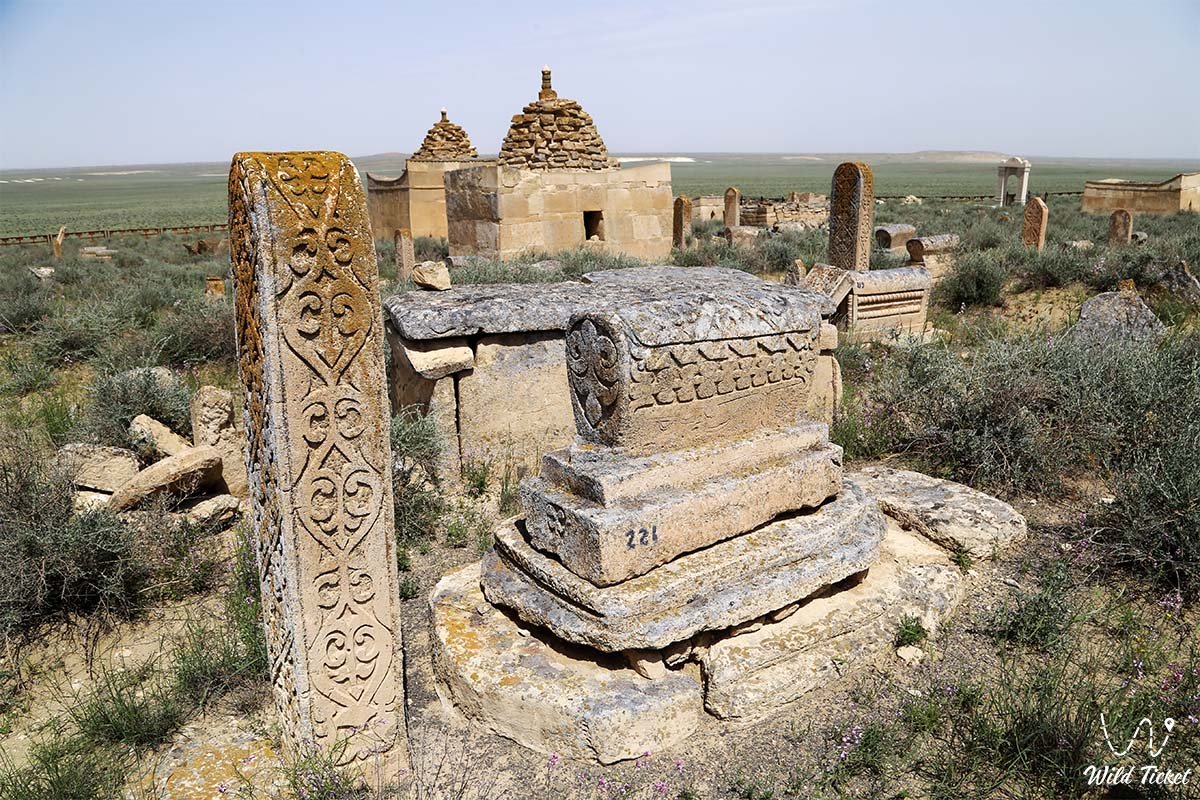
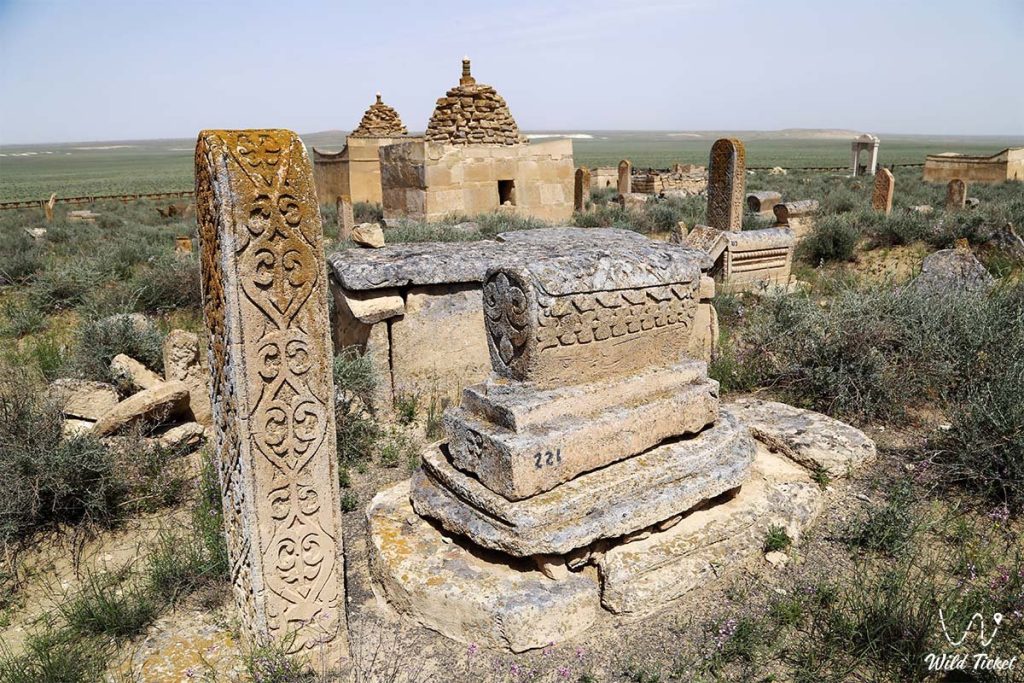
Surrounding Shir-Kabir lies a vast cemetery spanning dozens of hectares. It is a true ‘city of the dead’, where every headstone is a page of history.
The ‘Gyzlar-bibi’ Mausoleums
A special place is held by the small domed mausoleums linked by folk tradition to female saints—Gyzlar-bibi (‘The Holy Maidens’).
- Legend of the Protectresses: It is said that during an enemy invasion, forty pure maidens prayed in the mosque for the city’s salvation. As the enemy burst inside, the earth opened and shielded them; in the place of their disappearance, these mausoleums grew.
- Architectural Echoes: These minor tombs repeat the form of Dekhistan’s great monuments in miniature. They create a unique landscape of ‘rippling sand’, where an ancient brick dome peeks out from every dune.
Part 4: Archaeological Treasures and Secrets of the Digs
Mashad-ata became an object of close study in the 20th century. Archaeological expeditions (notably those led by M.E. Masson) discovered remarkable artefacts:
- Underground Crypts: Beneath the mosque floor, burials of nobility were found in brick sarcophagi. Despite the centuries, fragments of gold embroidery and silk were preserved on the clothing of the deceased.
- Ceramic Pipes: It was discovered that a separate branch of the water system led to the necropolis. This holy site was intended to be an oasis with running water for ablutions, even located amidst the salt flats.
- Five Centuries of Coins: Coin finds show that pilgrimage here never ceased, even after Dekhistan was deserted. People continued to journey to the ‘sons of Iskander’ through centuries of oblivion.
Part 5: The Magic of Ziyarat — A Journey of the Soul
For the Turkmen people, Mashad-ata is a site of Ziyarat (holy pilgrimage). It is believed that three visits to Mashad-ata are equivalent in spiritual significance to a minor Hajj.
Rituals and Beliefs
- The Tree of Desires: Near the ruins, one often sees old bushes or trees adorned with hundreds of colourful strips of cloth. Each cloth represents a request: for healing, for the birth of a child, or for peace within the family.
- Stones of Memory: Pilgrims leave small stone pyramids (ova) around the graves—a sign that a traveller was here seeking the intercession of the saints.
- Healing Dust: There is a belief that the earth of the necropolis possesses healing powers. Pilgrims often take a handful of soil to use as a protective charm.
Part 6: A Practical Expedition — How to See the Invisible?
Mashad-ata is located in an extreme desert zone. To ensure your journey is successful, follow these guidelines:
- Transport and Logistics: The necropolis is 7 km from Dekhistan. If you have reached the city, getting to the cemetery is not difficult, but remember: the salt flat is treacherous. At the slightest moisture, the soil turns to ‘soap’, and a vehicle can become hopelessly bogged down.
- The Hour of Contemplation: The ideal time is sunset. At this hour, the carved patterns of the Shir-Kabir mihrab begin to ‘play’ with shadows, becoming three-dimensional and alive. The red sunset light paints the brick domes the colour of copper.
- Pilgrimage Etiquette: Treat this place as a temple. It is customary to remove your shoes inside the mosque. Refrain from loud conversation—silence here is an essential part of the sanctity.
- Photography Equipment: Bring a powerful torch for interior shots (it is quite dark inside) and a macro lens to capture the minute details of the 9th-century carvings.
A Word from Your Guide: Standing at the threshold of Shir-Kabir, gaze at the horizon where the haze shimmers over the Misrian Plain. In that moment, it is easy to believe that the spirits of Iskander’s ancient warriors still patrol these walls, guarding the peace of a ‘Golden Age’ that remained here forever, frozen in fired brick and the finest ganch carvings.
🏆 Quiz from “The Great Book”:
Inside the Shir-Kabir mosque, archaeologists found the remains of an ancient wooden minbar (the preacher’s pulpit). Scientists were astonished to find that the wood from which it was crafted did not grow in these lands. Do you know which country, according to both legends and wood analysis, provided the cedar and sandalwood for the holiest mosques of Khwarazm and Dekhistan? (Hint: It is a country beyond the Himalayas, from whence spices and ivory were brought).