If Merv is the cradle of history and Kunya-Urgench a symbol of resilience, then Dekhistan (ancient Mashad-Misrian) is the most mysterious, austere, and visually stunning page in the chronicles of Turkmenistan. Located in the southwest of the country, within the Balkan Velayat, this ghost city rises above the utterly flat salt plains of Misrian like a giant mirage frozen in eternity.
Dekhistan stands as a monument to human triumph over nature—and a poignant reminder of how easily that triumph can turn to dust. In this chapter, we take a deep dive into the history of a city that was once a flourishing oasis of immense wealth, only to become a great ‘architectural skeleton’ in the heart of the desert.
Part 1: Geography of the Impossible — Life on the Salt Flats
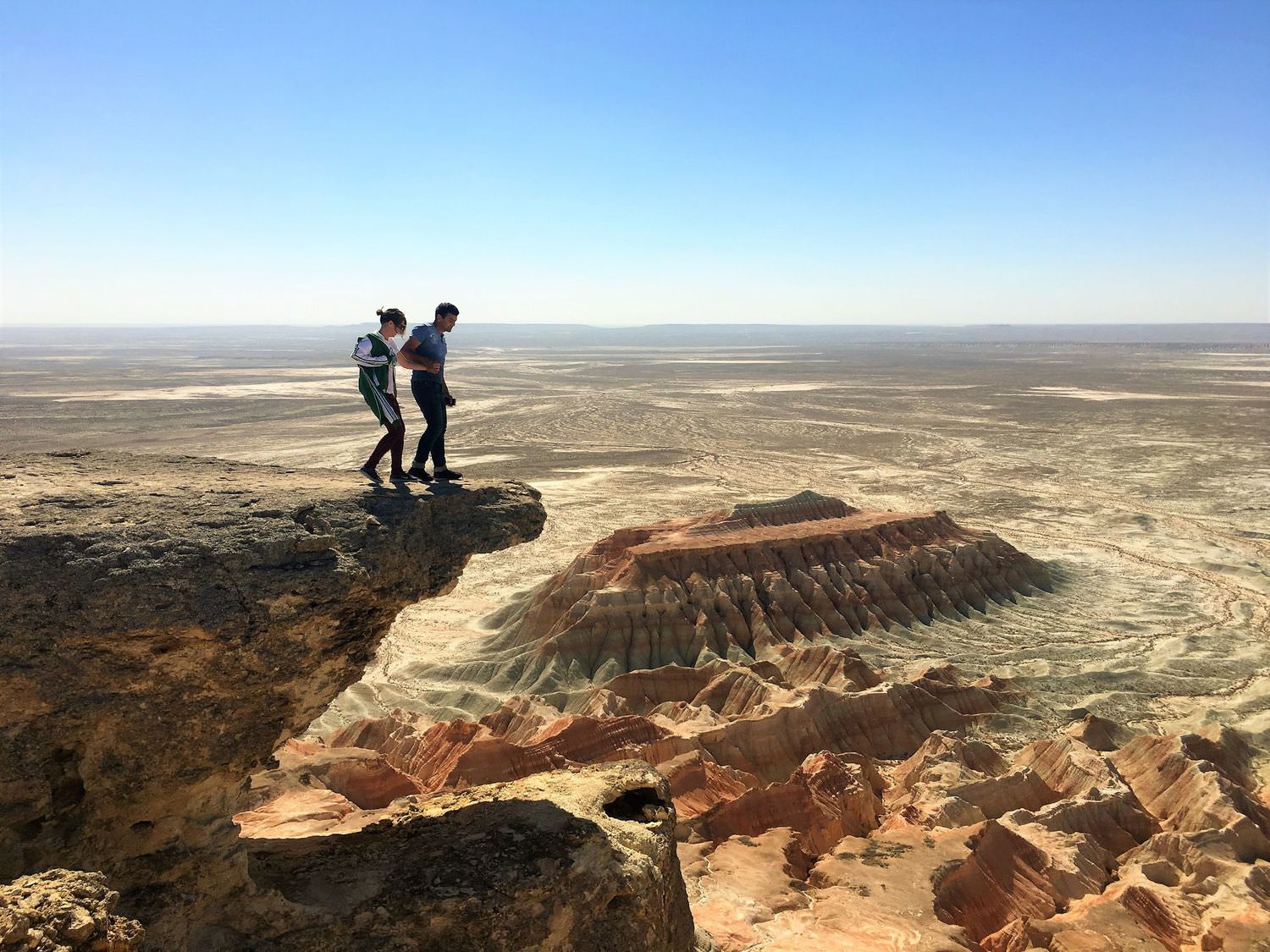
Dekhistan emerged in the 1st millennium BC, but its ‘Golden Age’ arrived during the reign of the Khwarazmshah-Anushteginid dynasty (11th–13th centuries). To comprehend the grandeur of this city, one must realise where it was built. The Misrian Plain is an arid plateau with virtually no open sources of fresh water.
The Great Irrigation Miracle
How could a metropolis with a population of tens of thousands thrive in such a place? The answer lies in the genius of ancient hydro-engineers.
- Qanats and Canals: Hundreds of kilometres of underground tunnels (qanats) and open canals stretched from the foothills of the Kopetdag to Dekhistan. The most ambitious was a canal that diverted the waters of the Atrek River.
- A Garden City: Thanks to this water, Dekhistan was surrounded by forests and orchards. Medieval Arabic manuscripts described it as a ‘place of paradise’, producing the finest fruits and grains, which were exported across the entire Silk Road.
Part 2: Architecture of Pride — Silhouettes Defying the Sky
The architecture of Dekhistan belongs to a unique tradition known as the ‘Khorasan brick style’. Here, glazes and paints were rarely used; beauty was achieved through a masterful interplay of form and the texture of fired brick.
The Minaret-Beacons
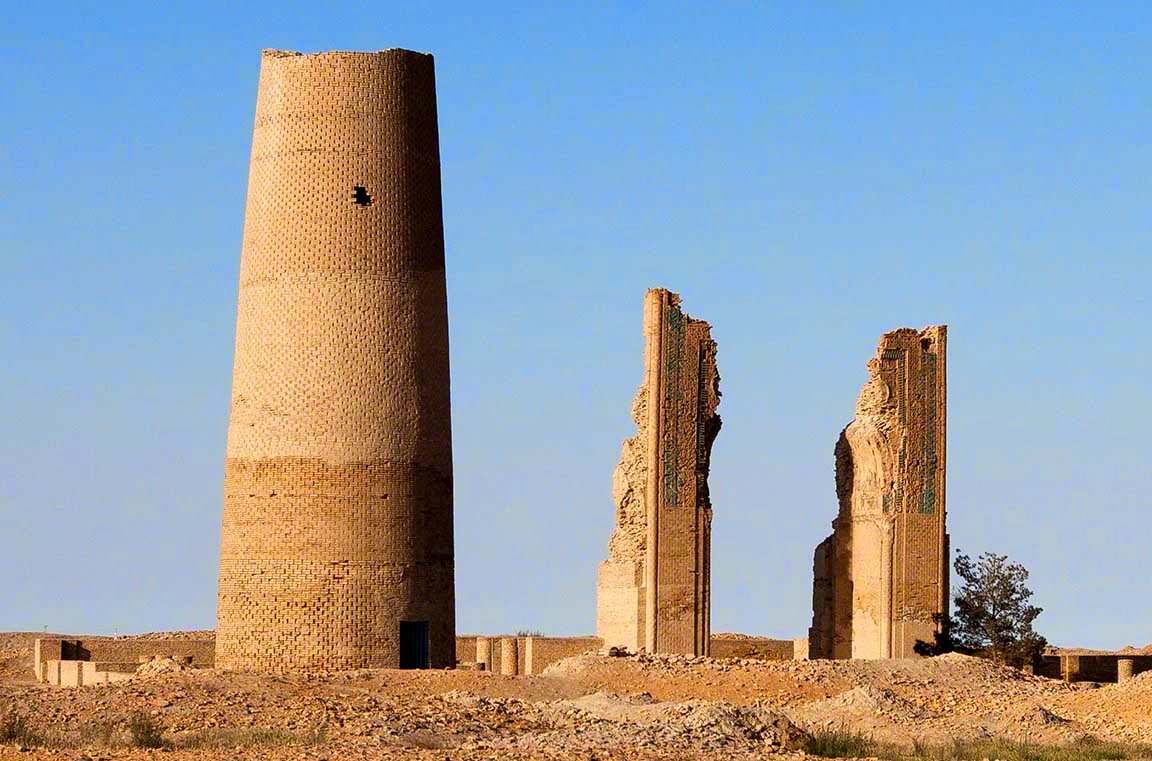
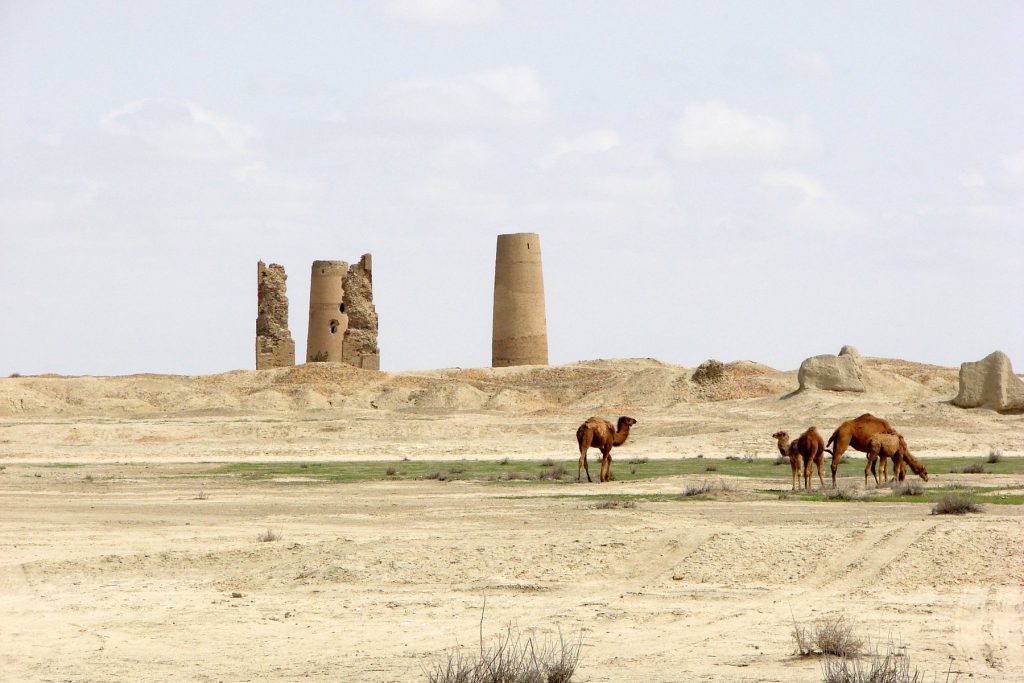
Two giant 12th-century minarets have survived in Dekhistan.
- Minaret of Abu Bini Ziyad: Its current height is approximately 20 metres (originally much taller). It is adorned with belts of epigraphic ornament—Kufic inscriptions meticulously laid out in brick.
- Minaret of the Muhammad II Mosque: Erected in 1102, it served not only to call the faithful to prayer but also as a landmark for caravans arriving from the Caspian. At night, fires were lit atop the minarets, transforming them into terrestrial lightships.
The Great Portal of the Cathedral Mosque
The most recognisable silhouette in Dekhistan is the ruin of the Khwarazmshah Muhammad’s mosque portal. This is a colossal arch standing over 18 metres high.
- Decorative Technique: The entire facade of the portal is covered in terracotta tiles featuring the finest floral carvings. Every brick here is an individual work of art. Look closely at the patterns: you will see entwined vines and flowers, which in Islam symbolised the gardens of paradise.
- Acoustics: The portal was designed so that the Imam’s voice would carry across the entire square, which once held thousands of people.
Part 3: Economy and Daily Life — The Caspian Trading Hub
Dekhistan was a ‘dry port’. Its position on the trade route from Persia to Khwarazm made it incredibly prosperous.
- Caravanserais: The city was encircled by powerful walls with dozens of towers. Inside were vast caravanserais where hundreds of camels could rest simultaneously. Here, currencies were exchanged, contracts were signed, and news from all corners of the world was shared.
- Ceramics Industry: Archaeologists discovered entire potters’ quarters in Dekhistan. The local ceramics were exceptionally durable and coated in a unique ‘lustre’ glaze that shimmered in the sun, mimicking gold.
- Metallurgy: Dekhistan’s blacksmiths forged the finest swords and arrowheads in the region, utilising secrets of tempering steel that arrived from Damascus and India.
Part 4: The Mysticism of the Mashad-ata Necropolis
Seven kilometres from the city lies the Mashad-ata memorial complex, which we discussed previously. This site is inextricably linked to the city’s history.
- Legend of Gyzlar-bibi: They say that a beautiful and wise woman named Gyzlar-bibi lived in Dekhistan, possessing the gift of healing. After her death, a mausoleum was built over her grave, becoming a site of pilgrimage. It was believed that even the dust from her threshold could restore sight or mend a broken heart.
- Mashad — A Place of Martyrs: The necropolis is believed to have arisen on the burial site of Prophet Muhammad’s companions, who brought Islam to this land. This gave the city the status of a holy place.
Part 5: The Tragedy of Disappearance — Where Did the Water Go?
Many cities perished by the swords of conquerors. Dekhistan survived the Mongol invasion of 1221, though it suffered greatly. However, its final demise was silent and inexorable. In the 14th and 15th centuries, an ecological catastrophe occurred. The Atrek River, which fed the oasis, shifted its course or grew shallow. The qanats, which required constant maintenance and massive human resources, began to clog with sand.
- The Great Exodus: The water vanished. First the orchards withered, then the city fountains. People abandoned their homes, taking only their most precious belongings. Dekhistan was not destroyed—it was left behind. The city simply fell asleep under the scorching sun, and the sand began to slowly reclaim its streets.
Part 6: A Practical Guide for the Modern Wanderer
Visiting Dekhistan is not a mere excursion; it is a true expedition into a ‘lost world’.
- Preparation: This is the most remote tourist site in Turkmenistan. From Ashgabat to Balkanabat is a 6-hour journey, followed by another 3–4 hours of off-roading. A 4×4 vehicle is mandatory.
- Timing: Early morning or late evening. At noon, the sun on the Misrian Plain is merciless, and the shadows from the minarets disappear, making the landscape appear flat.
- Safety: The Misrian Plain is full of wildlife. You may encounter rare birds, as well as monitor lizards (varans). Be cautious and always watch your step.
- Respect the Ruins: Dekhistan’s walls are made of mudbrick and fired brick, both of which are very fragile. Do not attempt to climb the portals without specialist equipment—it is dangerous for you and damaging to history.
A Word from Your Guide: When you stand in the centre of Dekhistan’s citadel, close your eyes and listen. The wind whistling through the openings of the minarets produces a low, humming sound. Locals say it is the city singing its final song, remembering the times when coins clinked and pomegranates bloomed.
🏆 Quiz from “The Great Book”:
In medieval Dekhistan, there existed a unique system of ‘postal communication’. Every 20–30 kilometres along the route to the city stood special towers. Do you know how they were used to transmit messages about approaching enemies or important caravans at speeds comparable to a modern telegraph? (Hint: They utilised the two fastest ‘elements’—fire by night and smoke by day).