Welcome to a city whose history resembles an epic drama of grandeur, betrayal, incredible fortitude, and eternal rebirth. Kunya-Urgench (Old Urgench) is not merely an archaeological park; it is sacred ground where, for millennia, the heart of one of the East’s most formidable powers—the Khwarazmshah Empire—beat with fervour.
During its zenith in the 11th and 12th centuries, Urgench was hailed as the ‘Heart of Islam’, the ‘Capital of a Thousand Sages’, and the ‘Rival of Baghdad’. It was a city where gold flowed like a river and libraries guarded the collective wisdom of humanity since Antiquity. Yet, destiny reserved for it trials unlike any other city: it was twice erased from the face of the earth by history’s greatest conquerors—Genghis Khan and Tamerlane.
Part 1: Capital of the World — The Splendour of the Khwarazmshahs
In the 12th century, Kunya-Urgench was the capital of a state that stretched from the Caspian Sea to the Persian Gulf, and from the Caucasus to the Hindu Kush. This was a Golden Age, during which the city became the pre-eminent scientific and cultural hub of the Orient.
The Mamun Academy: Genesis of Global Science
Few realise that here, in Urgench, centuries before the European Renaissance, the Academy of Sultan Mamun flourished. It was the workplace of titans of thought:
- Abu Rayhan al-Biruni: The supreme encyclopaedist who, as early as the 11th century, calculated the Earth’s radius and predicted the existence of the American continent.
- Ibn Sina (Avicenna): The father of modern medicine, whose ‘Canon of Medicine’ remained the primary textbook for physicians in Europe and Asia for 600 years.
Urgench was then a city of 400 mosques, hundreds of madrasas, and endless bazaars trading in Chinese silk, Indian spices, and European amber.
Part 2: Architectural Wonders — The Geometry of Eternity
The architecture of Kunya-Urgench represents the high-water mark of medieval building. Techniques invented here later provided the foundation for the masterpieces of Samarkand and Bukhara.
The Kutlug-Timur Minaret — An Arrow Piercing the Heavens
The tallest minaret in Central Asia, standing at 60 metres.
- Engineering Precision: Built in the 14th century, it possesses a perfect conical form. Within lies a spiral staircase of 145 steps.
- The Mystery of the Lean: The minaret has a noticeable tilt. Scholars still debate whether this was a foundation defect or a deliberate engineering choice to withstand earthquakes and wind loads.
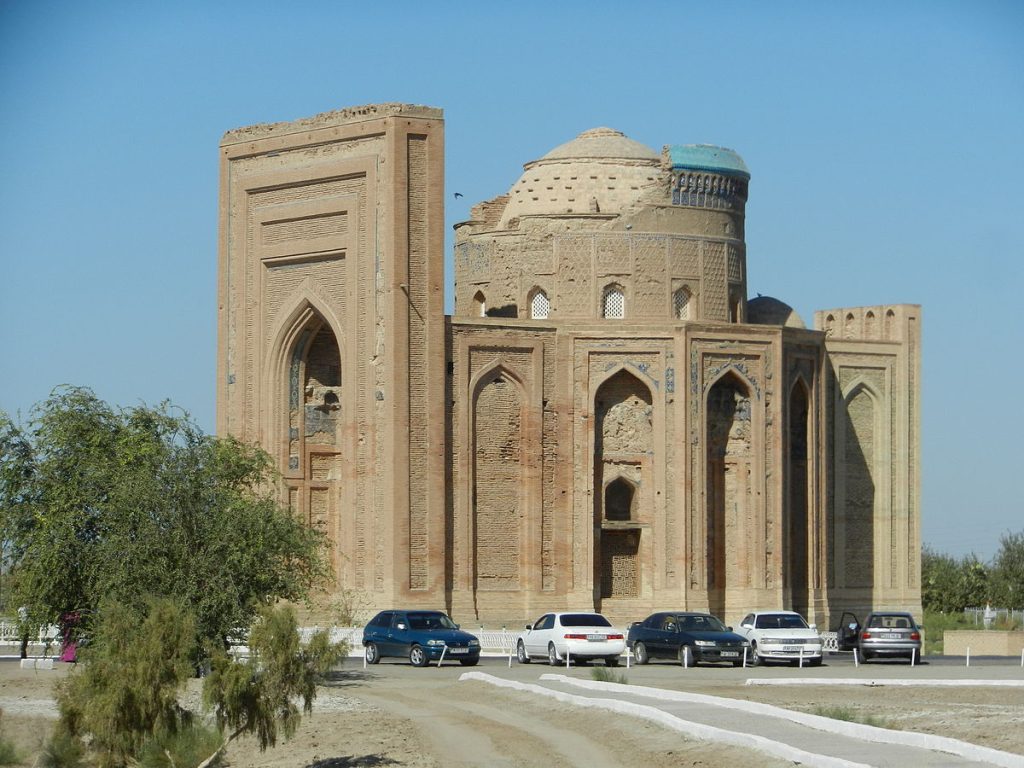
The Mausoleum of Turabek-Khanum — Heaven on Earth
Regarded as the most perfect monument in the Islamic world, it is dedicated to the daughter of Uzbek Khan of the Golden Horde.
- The Calendar Dome: The interior of the dome is a magnificent mosaic panorama. It depicts 365 stars (days of the year), 12 arches (months), 24 windows (hours in a day), and 4 large windows (weeks of the month). It was a literal astronomical observatory embodied in stone and azure.
- Mosaic Magic: The colours have not faded in seven centuries. The secret of the glaze, which included crushed gemstones and tin, remains one of the great mysteries of the Khwarazmian masters.
Part 3: Tragedy and Heroism — The Siege of 1221
In 1221, the hordes of Genghis Khan arrived. The siege lasted seven months. Urgench did not surrender lightly; legends tell of residents fighting for every quarter, every house.
- The Vengeance of Genghis Khan: Enraged by the Khwarazmians’ tenacity, the Great Khan ordered the destruction of the dam on the Amu Darya. The waters of the great river surged into the city, literally washing it away. Thousands of scholars, masters, and manuscripts perished in the deluge.
Yet the city survived! Within decades, it rose from the ruins to become a wealthy centre of the Golden Horde, until Tamerlane dealt a second terrible blow in 1388, ordering its total destruction and commandingly sowing the site with barley.
Part 4: Myths and Legends of Old Urgench
The Legend of Najmuddin Kubra
The great Sufi sheikh and founder of the Kubrawiya order remained here during the Mongol invasion. Genghis Khan, respecting his sanctity, offered him safe passage. The Sheikh replied: “I have lived with these people in joy; I shall remain with them in sorrow.”
- The Feat: Tradition holds that the 80-year-old saint faced the Mongol warriors with a sword. At the moment of his death, he gripped the enemy banner so tightly that the Mongols could only retrieve it by severing his hand.
The Hill of “Forty Mullahs” (Kyrkmolla)
A sacred hill where, legend says, the Mamun Academy’s library stood. As the Mongols breached the city, forty sages prayed for the salvation of their priceless books. The earth opened and swallowed them alongside the library. It is said that on quiet nights, voices can be heard from beneath the earth, reciting sacred texts.
Part 5: A Guide for the Pilgrim and the Traveller
- Spiritual Preparation: Turkmens refer to a visit here as ‘Kichi-Hajj’ (the Minor Pilgrimage). Approach it with reverence.
- The Route: Begin at the Mausoleum of Najmuddin Kubra to absorb the city’s spirit, then move to the Minaret and the majestic dome of Turabek-Khanum.
- When to Visit: Spring and autumn are ideal. The sky over Khwarazm becomes a piercing blue, perfectly accentuating the turquoise glaze of the domes.
A Word from Your Guide: Be sure to visit the local archaeological museum. The fragments of Khwarazmian water pipes and surgical instruments found during excavations help one realise just how technologically advanced this ‘Atlantis of the Sands’ truly was.
🏆 Quiz from “The Great Book”:
On the dome of the Turabek-Khanum mausoleum, the mosaic is laid so that the pattern never repeats. Mathematicians have discovered that complex geometric formulae are encoded within these designs. Do you know which great Khwarazmian mathematician, born in this region, invented Algebra and gave his name to the concept of ‘Algorithms’? (Hint: His name became the basis for the word “Algorithm”, and his work “Al-Jabr” provided the name for “Algebra”).